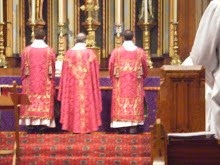
From the Anglican Communion News Service:
Anglican bishops oppose death penalty, Jamaica
Indeed. Neither the death penalty nor Jamaica can possibly be justified by right-thinking Christians.
Thursday, November 27, 2008

Tuesday, November 25, 2008
Talking points on Scripture and homosexual relationships
The best defence of the "reappraiser" position is to be found in Br Tobias Haller's "Sex Articles". For all their protests, none of the "anti" crowd have ever come up with anything nearly as sophisticated, and his points remain unrefuted .
Because of the density of his work, however, I have come up with my own cheat sheet to remind me why (lest I become complacent and take my position for granted) I regard the classic Christian position on homosexuality as untenable. Here they are:
***
*Because St Paul had no concept of an innate "homosexual" orientation (hence my double invert commas: it's an anachronism). You can't try to stretch what he says to fit a topic he wasn't writing about.
*Because St Paul was fallible. He was only the human instrument of divine inspiration.
*Because the Greek of the passages in question, to the extent that it is intelligible at all, seems to refer to specific forms of "homosexual" activity that we wouldn't recognise today.
*Because each of the passages in St Paul comes in the context of a broader rhetorical argument of which "homosexuality" is not the point. It's used as an example of depravity, one which would not have been questioned in that time and place.
*Because St Paul in general does not express a recognisably Christian ethic of marriage and sexuality. It's laughable—and incoherent—that so many who profess to believe in the sanctity of marriage (or rather, some marriages) take their cue on homosexuality from a man who didn't believe in that sanctity ("It's better to marry than to be aflame with passion," remember?)
*Because Jesus himself reduced the Law to a bare minimum expressed in the Summary of the Law and the Golden Rule.
Because of the density of his work, however, I have come up with my own cheat sheet to remind me why (lest I become complacent and take my position for granted) I regard the classic Christian position on homosexuality as untenable. Here they are:
***
*Because St Paul had no concept of an innate "homosexual" orientation (hence my double invert commas: it's an anachronism). You can't try to stretch what he says to fit a topic he wasn't writing about.
*Because St Paul was fallible. He was only the human instrument of divine inspiration.
*Because the Greek of the passages in question, to the extent that it is intelligible at all, seems to refer to specific forms of "homosexual" activity that we wouldn't recognise today.
*Because each of the passages in St Paul comes in the context of a broader rhetorical argument of which "homosexuality" is not the point. It's used as an example of depravity, one which would not have been questioned in that time and place.
*Because St Paul in general does not express a recognisably Christian ethic of marriage and sexuality. It's laughable—and incoherent—that so many who profess to believe in the sanctity of marriage (or rather, some marriages) take their cue on homosexuality from a man who didn't believe in that sanctity ("It's better to marry than to be aflame with passion," remember?)
*Because Jesus himself reduced the Law to a bare minimum expressed in the Summary of the Law and the Golden Rule.
Wednesday, November 19, 2008
He's a gay man now!
This post is dedicated to my mother, a somewhat less exaggerated version of the heroine in this sketch.
Monday, November 17, 2008
The Visitation of the BVM
Somehow, these never went up. They are from the final Saturday of the May Festival, at the Church of St Mary Magdalene.


Inside a Reformed Episcopal church
Mobile photos of St George's Reformed Episcopal Church, Hamilton (previously St Margaret's Anglican).


Friday, November 14, 2008
Thursday, November 13, 2008
"Ontological subdeaconness" and the extraordinary form
Patrick Cook pointed out today that I am only a subdeacon when acting in that capacity, since the Anglican Church has, for the most part, not ordained subdeacons since the Reformation. The Roman Catholic Church, outside of certain priestly societies with an indult, has not done so since the Second Vatican Council. Fr Clough, my last RC pastor (post passim), was among the last generation of seminarians ordained to minor orders and the subdiaconate while doing so was still "ordinary."
Until the publication of the Instruction Concerning the Criteria for the Discernment of Vocations with regard to Persons with Homosexual Tendencies in view of their Admission to the Seminary and to Holy Orders rendered my defection to Anglicanism necessary, it had been my intention to offer myself to Our Lady of Guadalupe Seminary in Denton, Nebraska, the setting of The Rocky Horror Picture Show. Affiliated with the Priestly Fraternity of St Peter, the seminary's formation includes a year of spirituality, two years of philosophy, and three years of theology. Beginning in the second year, seminarians begin the process of admission to minor orders before being ordained to the subdiaconate and Holy Orders.
Because it was my desire to follow this course (the wisdom of which I may now question with the benefit of hindsight), my lack of "ontological subdeaconness" is something of a sore point for me. But in the context of the Anglican Church of Canada, Patrick is of course quite correct. I wonder, though, if that means that it's wrong to say one is a server (as opposed to saying one serves at the altar) because the Anglican Church has not retained the minor order of acolyte. But perhaps I split hairs.
Until the publication of the Instruction Concerning the Criteria for the Discernment of Vocations with regard to Persons with Homosexual Tendencies in view of their Admission to the Seminary and to Holy Orders rendered my defection to Anglicanism necessary, it had been my intention to offer myself to Our Lady of Guadalupe Seminary in Denton, Nebraska, the setting of The Rocky Horror Picture Show. Affiliated with the Priestly Fraternity of St Peter, the seminary's formation includes a year of spirituality, two years of philosophy, and three years of theology. Beginning in the second year, seminarians begin the process of admission to minor orders before being ordained to the subdiaconate and Holy Orders.
Because it was my desire to follow this course (the wisdom of which I may now question with the benefit of hindsight), my lack of "ontological subdeaconness" is something of a sore point for me. But in the context of the Anglican Church of Canada, Patrick is of course quite correct. I wonder, though, if that means that it's wrong to say one is a server (as opposed to saying one serves at the altar) because the Anglican Church has not retained the minor order of acolyte. But perhaps I split hairs.
Subscribe to:
Posts (Atom)