24 December
*4.30pm Choral Evensong, Cathedral Church of St James (standing room only)
*4.30pm Evensong & Benediction, St Bartholomew's Church
*11pm Solemn Pontifical Midnight Masses at both St Thomas's (with the Primate) and St Mary Magdalene (with the Area Bishop, preceded by Said Mattins at 10.15pm). Musical preludes at 10.30 at both churches.
25 December
*12am Solemn High Mass (extraordinary form) at St Vincent de Paul Church
*10.30am Morning Prayer at St George's Reformed Episcopal Church, Hamilton
*11am Sung Mass in Latin (ordinary form) at Holy Family Church
*5pm Evensong at St John's Convent
6 January
*7pm First Mass of Christmass, Christ the Saviour Monastery, Hamilton
Looking ahead, the Procession and Solemn High Mass on Candlemass (Tuesday 2 February, 6.15pm) at St Thomas's, Huron Street, will be celebrated according to the Use of Sarum.
Friday, December 18, 2009

Christmass at S. Clement's
(Audio attack)
24 December
*10am Low Mass of the Vigil
*12noon First Vespers and Compline
*9.45pm Mattins
*Confessions: 5-6pm, 10.30-11.30pm
25 December
*12am Procession and Solemn High Mass of Midnight
*8am Low Mass of the Dawn
*11am Solemn High Mass of the Day
24 December
*10am Low Mass of the Vigil
*12noon First Vespers and Compline
*9.45pm Mattins
*Confessions: 5-6pm, 10.30-11.30pm
25 December
*12am Procession and Solemn High Mass of Midnight
*8am Low Mass of the Dawn
*11am Solemn High Mass of the Day
Thursday, December 17, 2009
The Eucharistic spectrum
In an introductory tract to Anglicanism I once read, the author stated that both memorialism and transubstantiation are outside of the scope of acceptable Anglican belief. At the time, this grated, because although I had found myself in Anglican Church for pragmatic reasons, my theology still essentially came from the Council of Trent. And indeed I continued to believe in the real absence of bread and wine in the Sacrament well in to my candidacy for Reception into the Anglican Communion.
Now I think I would grant the point. Anglicanism embraces the influence of Scripture, Tradition, and Reason (though differences abound about the nature of the interaction of the three). Memorialism or Zwinglianism is certainly against Tradition, as surely even Calvin would agree. But also, perhaps surprisingly (I would say ironically, but I am suspicious of my judgment of its use given my membership in my generation), it is unbiblical. Jesus tells us to eat his flesh and drink his blood. Those words did have idiomatic meanings then - to revile and condemn someone, akin to "chewing them out" today. Are we to condemn Jesus? It can't be explained away by a purely symbolic exegesis.
Transubstantiation runs into difficulty with reason. I don't think it's fair to compare it to memorialism, because I believe that in this case the problems are not insoluble. But in order for transubstantiation to work, it needs to be adapted so as not to assume Aristotelian physics as a premise. Outside of such groups as the Palmarians (who believe in the Real Presence of Our Lady in the Blessed Sacrament), surely no one believes that a chemical analysis (while blasphemous) would not show the chemical properties of bread and wine? Indeed, say what you will about Luther, his Eucharistic theology of the horseshoe in the fire is entirely Catholic: the fire and the metal are both present yet as one. So too do the Body and Blood of Christ coexist incarnationally with the bread and wine we give back to God.
Monday, December 14, 2009
Saturday, December 12, 2009
The Conception of Our Lady
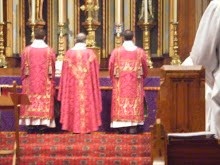
An unusually high number of people visited The Rose Maniple on Tuesday. For those who are interested, I marked the day with a Procession and Solemn Mass at the Church of St Mary Magdalene. The leaflet hasn't been posted, but this pdf from a couple of years ago is pretty typical - although, maddeningly, the processional hymn this year was to "Daily, daily."
The day before, on the feast of St Ambrose, I visited Trinity College Chapel, where the Dean of Divinity, the Revd Canon Dr David Neelands, presided at Holy Communion after the rite of 1552. There were some anachronisms. By habit, most people said some prayers (the general confession, the prayer of humble access, for example) that the rubrics clearly meant to be presbyteral orations. "O come, O come, Emmanuel" and "Comfort, comfort ye my people" replaced the metrical psalms that we had had sung the year before. Several people made liberal use of the Sign of the Cross. The Dean celebrated in a comely surplice standing at the north side (not end, for the orientation was done the right way) of the holy table, with an unrealistic number of communicants (last year, at least, they had to sign up in advance) kneeling in a circle around the perimeter of the chancel from the end of the Exhortation. The rector of St Thomas's, Huron Street, preached what I suspect may have been one of the Homilies.
Readers in the Southern Ontario area should note the celebration of the First Mass of Christmass at Christ the Saviour Monastery in Hamilton, Wednesday 6 January, tentatively at 7pm. The Hamilton Schola Cantorum will sing the propers of the ancient Western Rite.
My ideal parish profile
• Catholicized Prayer Book (Rite I-style) rite (p. 230) in the BAS supplemented by the Anglican Gradual and Sacramentary, OR 1962 BCP augmented by the Anglican Missal. The Gregorian Canon is wrapped around Eucharistic Prayer B in the former case; in the latter, around the Prayer of Consecration. If the older sources are used, Intercession, Confession & Absolution, and Blessing are retained, but the Comfy Words, and the Prayer of Humble Excess (or the Humble Crumble, if you prefer). The Preparations and Last Gospel are vestry devotions. Would use whatever authorized Eucharistic Lectionary I inherited.
• Early celebration (BCP, preferably in Latin, or SBH), breakfast, Sung Mattins (Anglican chant) & Litany, Solemn Mass (Asperges before, chanted Angelus after), Solemn Evensong (with Antiphon of Our Lady) & Benediction. Or, if there is an interested neighbouring Roman Catholic congregation, a joint service there according to the rite for Evensong or Vespers authorized by their ordinary.
• Ritual Notes and Fortescue interpretation. The Use of Christminster colour scheme is followed. I lean toward the lay subdeacons in maniples school of thought, but consider it an anomalous point of acceptable difference created by the situation where the diocesan does not ordain subdeacons. I have some Liturgical Movement preferences: I like Gospel processions, for instance, and I like to receive the Sacrament on Good Friday. I am in the process of compiling a supplement to Ritual Notes for the orderly implementation of these practices in congregations where they have become customary, but which otherwise adhere to traditional liturgical customs.
• Mattins, Mass, & Evensong (1962 Office lectionary, 1918 if I can get away with it) seven days a week. Votive of Our Lady on Saturday, weekly requiem. Corporate Confession & Forgiveness (LBW) with individual absolution at the altar rail on Saturday evenings.
• Predominant emphasis on congregational chant. Lots of psalm tones.
• Close relationship with any nearby religious communities, full communion partner congregations (I just realized the other week that Sankt Georg is around the corner from St Mary Mag. Potential? There are two Mar Thoma congregations in the Greater Toronto Area).
• Strong student outreach, Christian Education, Company of Servers.
• Social justice activities; readiness, given the availability of necessary means, to offer the protection of the Lord’s sanctuary to victims of the faulty immigration appeals system. Relationship with Catholic Workers and SCM. Focus on spiritual and corporal works of mercy.
• If I were to find myself in the US, read the following as equivalent. Re-ordered rite = Rite I. 1962 = 1928.
• In an English context, I would be happy to serve any Resolution C parish maverick enough to put up with my concelebrating at both Chrism Masses.
Friday, December 4, 2009
Why Anglicanorum coetibus is not a big deal
*Lay people don't care about retaining an Anglican-style liturgy. They are either liberals, who would gladly have gone over after Summorum Pontificum but for their views on women and/or gays, or the rare remaining ultramontanists whose motives for not doing so are mysterious. But in either group Anglican rubrics are typically seen as constraints, rather than a "patrimony" preservation whereof is desirable. (The Book of Divine Worship is not safe for those who suffer from requiem-onset allergies to the A-word, and the English use the Pauline Missal anyway). The best reconciliation of North American Anglo-Catholic practice with the authorized provincial texts is the Anglican Gradual and Sacramentary linked at the sidebar. The archetypal Anglo-Catholic parish, S. Clement's, Philadelphia, is known for its faithful execution of the Pre-Pian liturgical tradition. And it is a parish of the Episcopal Diocese of Pennsylvania, under Her Grace's metropolitical primacy.
*The bull is soft on the provision for married priests. They won't be allowed in the same way as in most Catholic rites apart from the Latin. So the clerical draw won't be as big. And of course, no women need apply. (Recall that there are women in diaconal orders who are card-carrying members in good standing of Forward in Faith. I would speculate that even the All Saints Sisters of the Poor, whose departure I lament, would have countenanced a hierodeacon among their number. But then I'm a shameless optimist. I'm already musing about Massachusetts-resident clergy ministering in Canada).
I predict that Western Rite Orthodoxy, which offers an ancient Western liturgical tradition, a married priesthood, and unquestionably authentic apostolic pedigree, will be far more successful. Meanwhile, the "liberal" Catholic wing of the Canterbury-affiliated churches in North America will acquire greater visibility.
Subscribe to:
Posts (Atom)