Friday, October 15, 2010

The Catholic Apostolic Church on Gould Street

From John Ross Robertson's Sketches in City Churches (1886).


NO. 22. -CATHOLIC APOSTOLIC.
A CHURCH WITH CULTURE—A NOVEL AND BEAUTIFUL SERVICE CONDUCTED ACCORDING TO A RICH RITUAL—ITS DOCTRINES AND ORIGIN.

At the corner of Gould and Victoria streets stands a white brick church, with a well proportioned outline, surmounted with a very graceful spire. Aside from the handsome spire which gives dignity and beauty to the edifice there is nothing architecturally attractive about it. The building was originally owned by the St. James' Square Presbyterian church and was sold to its present owners a few years ago for $10,300. An arched doorway in the front, on Gould street, is reached by a flight of steps, the only entrance now used. Above it is a group of lancet, cathedral class windows, with a small "rose" window above, and still higher a stone on which is inscribed: "Christo, A.D. MDCCCLV." A small gallery above the vestibule accommodates the choir and contains an old-fashioned, yellow painted, ten-stop organ, but one whose appearance gives no evidence of the volume and harmony of sound it is capable of producing. The room will seat about 400 people and is very plain in its furnishing; the walls are stuccoed in stone colour, and the ceiling, supported by light trusses, is frescoed in panels. Three gasaliers hang from it, while in front of the altar a perpetual light is kept burning in honour of the Presence of God as symbolized in the eucharistic elements kept in the gold-lined tabernacle. Above the altar is a panelled space, whose background is blue, sprinkled with gilt stars, the arch of which is maintained by white columns. Above this arch and near the ceiling is a group of three cinque-foil windows.

A large section of the front part of the building, on the south, is set apart for the chancel, on either side of which is a dark wood partition, forming a passageway to the ante-rooms and robing rooms downstairs. Against the eastern wall, and entirely without the limits of the chancel, is a large circular enclosed pulpit; no railing divides the chancel from the main part of the room, but it is considered to be a very sacred place. When the reporter visited the building he was particularly cautioned not to set foot upon the highest of the four platforms because it is "holy;" even the caretaker does not go there for the purpose of cleaning and dusting; this work is only done by an official whose consecration gives him admission to the sacred precincts. On the main floor are small kneeling desks for the deacons present who and are habited with black cassocks and white surplices and whose duty it is to assist the priests during the service. On the first platform, about four inches from the floor are stations for the two elders or priests who assist the angel or bishop; here are also, on either side, reading desks, one the Epistle, and the other the Gospel. On the next platform are eight stalls for the nonofficiating priests and a high-backed oak chair for the bishop and a table for the eucharistic vessels. On the third elevation are simply hassocks and cushions used by the officiating bishop and priests while the fourth elevation contains the altar, a pretty but small piece of furniture made of black walnut with red and yellow ornamentation and the monogram J. H. S. inscribed.

The bishop's and other officials' robing rooms are in the basement, a rather dilapidated looking room with the old Presbyterian pulpit still standing. It seems to be in accordance with the tenets of the people worshipping in this church not to lay so much stress upon the outward building as upon the ritualism of worship and the special ornaments, vessels and robes used in the celebration of their services.
"What time do you have service on Sunday morning?" was asked one of the members.
"At half-past ten, sun time," was the reply; "we do not follow times and seasons that man has made; we go according to the time God has ordained, not according to man's changes. After dark then we go according to city time."

Accordingly, last Sunday morning a Telegram reporter entered the church for the purpose of acquainting himself with the method of worship that obtains here. Just within the door is a small wooden box containing a bowl of water into which every member dips his fingers and touches his forehead with it, sometimes making thereon the sign of the cross. Next to this bowl of water is a long narrow box divided into compartments for the reception of the offerings. No collections are taken in this church, but each member is expected to contribute one-tenth of what he earns during the week; if he earns $10 then he should give $1 to the church; if he earns $50 he should give $5, and so on. This part of his alms-giving goes into the "tithes" apartment, and whatever more he can contribute he may give to either the " poor fund," "evangelistic work" or "building fund." All the offerings are purely voluntary; no pews are rented and no assessment of any kind is levied.

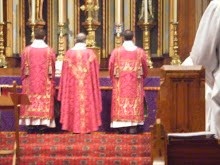
In front of a large stone baptismal font and directly behind the pews are three stations for the black-robed under-deacons, whose business it is to supervise the seating and comfort of the congregation. About 150 people were present last Sunday morning; people of all ages from the old, whitehaired man, whose sun of life is very near its setting, down to the little child for whom life is just budding into beauty and joy. They were what would be termed of the middle-class of our city's population, and had the appearance of sober, earnest and discriminating intelligence. Their distinguishing characteristic was that of sincerity and reverence; although the service was longer than an hour and a half, there was not the slightest token of impatience or of indecorum; even the little children were worshipful, and it seemed as if some other than mere earthly influence kept the congregation so devout and respectful. Service is held Sunday morning at 10 o'clock and in the evening at 5 o'clock, and also every day at 6 a.m. and 5 p.m. On every Sunday morning the eucharistic service is held, the central and most significant of all services and one whose solemnity and cultivated ceremony are not surpassed by any other service in this city. After a brief preliminary service the consecrated elements are removed from the tabernacle of the altar by the celebrant, a bishop or angel, assisted by two priests or elders, and attended by five deacons; in slow and orderly procession these withdraw to the rooms below where the bread and wine are consumed. During their absence an organ voluntary was played; in ten minutes the procession returned, the bishop and priests having removed the plainer vestments and substituted very nice robes; there is no genuflection before the altar, but there is frequent bowing, and whenever in the service the name of Jesus is pronounced the officials and people always incline the head.

The ritual, while it is a composition of the most elegant portions of the Latin and Greek formulae, yet very closely follows that of the Church of England. The service is entirely choral and the responses and versicles, which are sung chiefly to Tallis' Church of England setting, are given, not by the choir only, but by the entire congregation and mainly without an organ accompaniment. The confession was said while the bishop faced the altar; it, as well as all the prayers and the absolution, were responded to by the congregation in choral unison; the bishop then turned and faced the people while he pronounced the absolution. The epistle was read by one of the priests, a young man, while the Gospel was read by Rev. Joseph Elwell, formerly a clergyman of the Episcopal church, who also pronounced a brief homily emphasizing the distinguishing features of this church, viz.: The guiding influence of the Holy Spirit and the second advent of Jesus Christ who is to come and set up a material kingdom in this world. The speaker, a whitehaired old man of patriarchal and dignified bearing, used no arts of oratory or diction; he spoke simply, plainly, sincerely and confidently. Indeed the

SERVICE WAS REMARKABLE
for a singular combination of this simple reverence and dignity with the most classical and cultured finish. It was so superfine in conception and so cultivated in execution, and had about it, by virtue of its simplicity, such a refining and uplifting and helpful spirit that no other service can possibly exceed it in these respects. And it was fertile of suggestion; the small company of the "sealed," as the members are called, and their positive conviction of the presence ot the Supernatural Comforter reminds one of that "little upper room" in Jerusalem where only the Master and the twelve communed. The table with its rich and chastely wrought silver service, covered with delicate white linen, the embellished robes of the priests, the perpetual fire before the altar, the rising cloud of perfumed incense wreathing a benediction above the Symbols of the Presence, the white-haired ministers, the simple pomp and dignity of it all — who is not reminded thereby of the tabernacle of the wilderness and the later glory of the golden-walled temple?

"Men amuse themselves with empty abstractions," said the homilist, and while all this ceremony, so beautiful and impressive, may be thought an abstraction by some it is a reality to these sincere people, because directly underneath it is the real living Presence of the Holy Spirit and these vestments and sweetly-smelling incense and emblems are simply the outward robes veiling a spiritual reality. Their faith in the sacrament is very strong, and they sometimes associate with its administration healing properties. One of the members assured the reporter that in a certain critical case when the patient was declared hopelessly ill by several physicians the sacrament was administered in extremis and the patient recovered.

AN IMPRESSIVE RITUAL.
After the homily the people rose and recited the Nicene creed. When the words "He was made man" were said all heads were bowed and there was a pause of a few moments as if the wonderful incarnation were too stupendous a fact to be passed glibly and thoughtlessly over. Then two of the deacons brought the offerings in two cloth bags, prettily ornamented, and passed them to the priests and they to the bishop, who deposited them upon the side table with the sacred vessels. The latter were then carried to the altar; two white-robed boys brought the censer and incense to the deacons; they passed them to the priests and they to the bishop who sprinkled incense upon the live coal and the white smoke wreathed a fantastic column up over the altar and spread a canopy of sweet odour above the shrine. While the emblems were being placed upon the altar the choir sang an anthem with excellent taste and expression that materially added to the solemn impressiveness of the service. After a prayer, all the officiating ministers kneeling before the altar, the preface to the consecration was said; the choir and people sang a Sanctus, in English — all the service being in the English language. The consecration was done while all the people knelt; the celebrant took a large wafer of unleavened bread in his hand and raised it with both hands high above the altar and when he repeated the words "broken for you" he broke the bread which, with a loud, crackling sound, then fell in small pieces into the silver salver below. When he said "this is the cup" the chalice was uplifted in the same way; the censer was swung above the altar after the consecration; at all other times it was quietly held by one of the priests. A litany then followed very similar to that of the Church of England; it consisted of a very long series of prayers, with choral responses, among them being special supplications for the Queen and Royal family, for the Governor-General and Parliament of the Dominion, "now in session," and for the Lieutenant-Governor of this Province; there was also a petition in behalf of the Virgin Mary recognizing her virtue and dignity as the Mother of Christ.

The hymnal of the Catholic Apostolic Church is a special collection issued by the authorities in England and embraces selections of the best order. After the litany a hymn was sung, the congregation standing; another prayer said and then the celebrant knelt and partook of the elements, presented the same to the priests and deacons, then to the people who came forward promptly and orderly and knelt before the altar during the administration. After each sup of wine the minister dextrously and neatly wiped the chalice before passing it to the next communicant; each one when he rose bowed towards the altar, returned to the pew and there knelt for a moment's silent prayer. It was not only an interesting observance to an outsider but its conduct was so dignified and reverential and impressive as almost to create a sensation of awe.

The communion is administered in both kinds to men and women and, on Christmas, Easter and Pentecost, to the children; each child as soon as it can kneel alone receives the communion, but at no other time save on the festival days just named or when dying. The conditions of membership are simply baptism and submissal to the pastorship of a certain bishop, and the baptism administered by any other church is considered valid. With the ministry, however, it is different; only those who are recognized to be ministers who believe in and


stand in the order of Apostolic succession ; hence Roman Catholic, Greek Catholic and Church of England priests only are considered authenticated.

MOVED BY THE SPIRIT.
After all the people had communed the three black-vested under-deacons came forward and were served; the vessels were removed to the table and what of the elements remained was put in the tabernacle of the altar until next Sunday, when the same ceremony will be repeated. At this point in the service a woman seated in her pew began an exhortation; with her eyes closed and her hands moving gracefully up and down, she uttered such thoughts as, it' is said, were inspired into her by the Holy Spirit. This supernatural influence is said to immediately possess and inspire the priest when he preaches. In fact the Catholic Apostolic church is founded upon what is called the restoration to the universal church of prophetic gifts by the direct inspiration of the Holy Ghost. And each official occupies the position he does in accordance with the measure of his inspiration. Should any member feel called upon to exercise himself in the way of utterance or service it is his privilege to do so without any formality. After a short prayer of thanksgiving a Te Deum was sung, and effectively sung ; then the bishop, or angel, pronounced the benediction; the people all silently knelt a few moments afterward and then, reverently withdrew, thus ending a service the beauty of which has not been seen by a considerable number of Toronto's citizens, and cannot, therefore, be either understood or appreciated. Other churches are more popular and have all the concomitants of wealth, and yet it may be safely said that no church in the city has a service whose aesthetic value is so great as this; with a rich ritual, classical music and a cultivated ceremonial, those people may well rejoice in the possession of a religious faith that comes to them clothed in such beautiful garments. And not only this, but the character of the people who worship there is of the cleanest kind; some of our prominent men are associated with the organization, and their wellknown probity and gentleness of spirit honour not only themselves but the institution in which they have unqualified faith.

Mention has already been made of the excellent music that may be heard there. It should further be stated that the services of the choir, twenty voices, and of the organist are given gratuitously, and in these days when so few good singers are willing to praise the Lord without being paid for it, this is a remarkable fact. The psalms are sung in unison to Gregorian tones; an Agnus Dei, by Webbe, a Gloria in Excelsis, by W. Holmes, a selection from Farmer's Mass in B flat, and one from the Bridgewater service in F were among the excellent renditions.

The pastor, interchangeably called the minister or bishop, or angel, receives no salary. All the tithes are laid at the feet of the Apostles, the superior officers, and they apportion it, quarterly in advance to the angels as a benefice, which is a totally different thing from a salary: there is no claim upon the fund.

HOW THE CHURCH ORIGINATED
There are about 300 people connected with the Catholic Apostolic church of this city; a Sunday school is held, where the children are assembled and taught the doctrines. In 1834, Mr. Caird, an evangelist, came here from England and remained two weeks, but no practical results followed his visit; two years later he returned and preached during the autumn until an Apostle came, in November, accompanied by a prophet, an evangelist and a pastor. By their efforts a congregation was organized, and in January, 1837, Rev. George Ryerson was ordained as the minister in charge; several were presented and some were called and ordained to the priesthood and others set apart as deacons and the church was active until 1844. Many ministers moved away because the seat of Government was changed, and this compelled the closing of the church until revived by Rev. Mr. Ryerson in the fall of 1848. He was succeeded by Rev. Mr. Elwell and the present incumbent.

The Catholic Apostolic church originated in 1830 in the west of Scotland. According to its belief the gifts bestowed by the Holy Spirit, which had been lost to Christendom, were restored at that time and in the persons of several distinguished men. It is popularly imagined that Edward Irving is the originator of this church and sometimes its people are called Irvingites; but this is an entirely erroneous idea. It is true that Edward Irving was one of those "called" and specifically endowed but only one; no doubt the movement owes very much to the singularly sweet and gentle disposition of that man, but it was by no means originated by him. Twelve of these especially endowed men, called "Apostles," met and agreed upon a visitation to different lands, first forming, July 14th, 1835, what is called the "College of the Apostles." They separated, examined the cultus of Christianity in all its different forms in different lands, and then culled from this universal life the very best of its ritual and organized the present form of services.

ONE LORD, ONE FAITH, ONE BAPTISM.
The Toronto church is in connection with and subordinate to this Apostolic College, whose headquarters are in Albury, England. These apostles, with prophets attending them, visit all the churches and ordain the priests by the laying on of hands. Every minister must be specially called by the Holy Spirit and every member must recognize this supernatural direction.

It is not a sectarian denomination, but claims membership of the one body to which all baptized persons belong—the one, holy, Cathloic apostolic church. It holds no other faith than that of universal Christendom. It adopts no other confession than the three great Catholic creeds which have been used in the universal church for fourteen or fifteen centuries, viz., the Apostles', the Nicene and the Athanasian creeds; and reaches no doctrine which has not been current in the Church, with the exception of the doctrine concerning the second coming of Christ, which was taught in the earlier centuries, but has fallen into neglect and forgetfulness ; and also that of the permanence of the spiritual endowment of the Church and the gifts of the Holy Ghost as taught in the New Testament.

Friday, September 24, 2010

An unreasonable fiat

(My thanks to John K. for broaching my post passim).

I appreciate the attempt, but I'm afraid there is nothing new here. That there is a difference inherent in the activities themselves is precisely what is at issue - you seem to reiterate this claim without providing any further reason for believing it than has been given so far.

As for Paul on heterosexual marriage, I did state that as a premise without explanation, since as you say I assumed some prior familiarity with (even respect for!) the texts in question, and Paul's toleration of marriage as "better than to burn [with desire]" is a far cry from "an honorable estate."

I'm afraid you've missed the point about gender; it isn't a straw man at all. If the moral status of the behaviour depends on the gender of the parties involved, then clearly something about gender is being assumed. Otherwise, it would be incoherent to claim that God forbids one and blesses the other. As you demonstrate, reasserters are very good at repeating this assumption, but evidence for it is less forthcoming.

You are moreover not "a member of another group likewise limited." You may be constrained from sleeping with other women, but you are not forbidden from sleeping with *any* woman - the Church has an existing approved context for you to do so. Gay people on the other hand have no such option, and so precisely what they are supposed to do in order to gain God's approval is not clear.

As for the burden of proof, again you offer mere contradiction. Gay people are the accused: it is not our responsibility to prove our innocence. That changing the pronouns in the marriage service is a "change" in the first place, much less an "abandonment of the old faith" is precisely the unexamined assumption that I am challenging. Gay Christians who wish to marry wish to do so *because* they believe in the old faith.

I'm a little unclear about your response to the scientific arguments, in which you say "the issue is not orientation." I'm not sure that that makes a difference to that segment: the point is that penalizing people for making what would appear to be, if sinful, the least sinful option feasibly available to them is unfair. Nor do I in fact think that we can draw such a glib line between orientation and behaviour: it puts gay people in the position, as I say, where their orientation precludes them from "behaving" in the approved manner. And since we don't condemn married couples for such behaviour, it would seem that it really is about the gender/orientation. Otherwise, we seem to suggest that there is a morally inherent difference in orifices, which you're free to argue, but smacks a bit of materialism and can hardly just be assumed as a 2000 year consensus - clearly there are many for whom it does not at all go without saying. And as I say (again you don't address this) we seem to have realized this when it comes to women's ordination, so to not extend the same conclusions to SSM seems to be special pleading.

I certainly don't want a religion that changes with the times: indeed, I am attracted to Christianity precisely because of its counter-cultural nature and rejection of the values of the world. But I do want a religion that has the humility to admit when it has been inconsistent, and if it has been teaching different things about these two types of relationships without a moral distinction to support the difference. In the same way, I consider the ordination of women not a "change" but an ironing out of a disparity between our practice of ordination and the Chalcedonian affirmation that Christ's human nature is from his Mother. I do agree that it demonstrates the divide: it's clear that some Christians view the Bible as an omnicompetent text whose stipulations are all equally authoritative irrespective of how absurd some of their possible conclusions can be shown to be. They are entitled to that, but it is unfair to expect the Anglican Church as a whole to affirm their private opinion as a matter of policy. If you believe that same-sex relationships are forbidden by God, good for you: avoid such relationships. But to crusade against those trying to play with integrity the hand they've been dealt is unchristian. (And lest you think I have a dog in this I live a celibate lifestyle myself, but I am acutely aware that this is a vocation from God that must be discerned and cannot be imposed en masse on an entire category of people).

Anyway, thanks for trying, but it still sounds like an evasion of the actual issues I've tried to raise.

Sunday, September 19, 2010

A parallel

Groups of Anglicans such as the Traditional Anglican Communion - not to mention other bodies like the Anglo-Lutheran Catholic Church - are seeking to be in full communion with an ancient see. (In contrast with the Roman Catholic Church's nomenclatural philosophy, I claim no proprietary right to "Anglican" for those of us in what the Continuum - we hope affectionately - call the Canterbury Communion). Taking Newman as their inspiration, they have been able to do so on relatively advantageous and congenial terms(we are talking about the Roman Curia here - though heavy hermeneutics have already begun on the passages relating to future married men in the priesthood). In the coverage of the topic, tribute has been paid to those pioneering co-religionists who "went over" prior to the bull, for whom the decision, which as any of us who has made one like it can attest, is not easy at the best of times, was decidedly less so.

I came to Anglicanism through Old Catholicism. While I continue to appreciate the formation I received in the latter and respect its (now quietly burgeoning) ministry, Utrecht has, rightly or wrongly, given up on North American bodies for the time being, despite close calls in Toronto and New Westminster, which were nail-biters for Ultrajectine-minded Anglicans (a particularly identifiable demographic in the United States). At BCP services, I hum my way through the filioque, I celebrate the Immaculate Conception and Assumption as edifying mysteries rather than mandatory dogmatic definitions, and I believe in the sacramental sufficiency of general absolution (even though I personally find private reconciliation necessary to my spiritual ben esse). But longing for something with, well, a congregation, I joined the Anglican Church of Canada, the only church in Canada in full communion with the Union of Utrecht (apart from an Aglipayan congregation meeting in an Anglican church in Montreal).

Saturday, September 18, 2010

By their fruits ye shall know them: a consequentialist analysis of the negative perspective on same-gender unions

Like a good Kantian, I have tried to focus on the moral reasons for same-sex marriage in my attempts to conduct a reasoned discourse on the public record. Here I will change tracks and look at the reasons why the traditional prohibition of same-gender relationships is not viable irrespective of the witness of Scripture and Tradition on the subject. The following constitutes the bare minimum I expect answered from anyone who wishes to maintain the traditional view, failing which I will take the point to be conceded and expect unanimous assent next General Synod. Apologies for my absence; coverage of Divnity orientation week will follow shortly.


***
It assumes the distinction it seeks to create.

Ultimately, the fatal flaws of the reasserter argument are its question begging and special pleading. Proponents point to a handful of texts concerning some form(s) or other of ancient near eastern same-sex activity. At the same time, the Church blesses heterosexual marriages, about which St Paul is hardly more enthusiastic. Thus in electing not to do the same for same-gender couples, the Church tacitly assumes that there is something qualitatively different about them from the relationships that it does bless. As this is ultimately the conclusion of the reasserter argument, it cannot also be a premise, much less a "missing" implied one. Leaving aside the biblical texts (horrors!), the problem is the paradox of our own practice. Apart from a nod to procreation - and even that is paired with the Godly raising of children - there is nothing in our marriage service that limits its scope to heterosexuals. (I noted with interest that over at the Anglican Samizdat there was as much outrage over +Montreal's tweaking of the existing blessing of civil marriage rite as +Niagara's publication of a rather twee de novo one, even though the former could hardly be said to change any doctrine since the wording is virtually identical apart from the pronouns).

If a distinction is to be made in the Church's response to heterosexual and homosexual relationships, it must either be rooted in some distinction inherent to the relationships themselves, or else an arbitrary commandment or "chuk." Reasserters, unsurprisingly, have not been able to account for this distinction (hint: it's not there).

It has decidedly questionable implications for our sacramental theology and our theological anthropology of gender.

Since the only distinction from all heterosexual unions common to all same-gender unions is the gender part, the assumed qualitative distinction, if it exists, must subsist therein. This model then has to elevate a biological triviality to the level of dogma. If we are going to accept this position, as reasserters would have us do, we should have to admit that genitalia are or can be a real barrier to receiving a sacrament - leaving the "I've got mine" female Essentials clergy who exhausted their capacity for "innovation" in 1976 on thin ice. Reasserters are asking us to accept a view that Anglicans (including most of themselves) rejected with respect to ordination. To arrive at a contrary and inconsistent view with respect to marriage belies their claim not to be singling gays out. It's all very well to complain about revisionist teaching, but rather more opaque when one wishes to pick and choose the instances in which revision is applicable once it has already been made. (As they say in the US Congress, wasteful spending always seems to be done outside one's own district).

It creates a class of Christians who have no hope of fulfilling the Church's teaching on chastity

While heterosexual Christians have the option of marriage, gay Christians are placed in a position whereby anything they do is automatically categorized as sexual sin. Apart from the relatively few Christians of any sexual orientation with a genuine celibate vocation, it is never quite clear what those who find themselves to be gay are meant to do under the reasserter model. Once they have made their case for why we are SOL, they are alarmingly light on advice.

Its credibility is undermined by its proponents

Apart from the odd kapo à la David Ould, the antigay industry is largely a unidirectional enterprise engaged by heterosexuals against a group in which they can be assured of never finding themselves. It is prima facie suspiciously convenient that the form of relationship uniquely sanctioned by God in their view is their own. As Anne Lamott says, "You can safely assume that you've created God in your own image when it turns out that God hates all the same people you do." Reasserters will take pains to profess Christian charity, yet it is still hard to fathom why even someone sincerely convinced of the traditional position on homosexuality would make a theological career out of seeking to deny a sacrament to other Christians. In the secular world, the slogan is "Don't like gay marriage? Don't have one." It is one thing for groups like Essentials to be averse to the notion of equal marriage, but to insist that one simply cannot inhabit a communion where two blokes might tie the knot in the next parish over is decidedly odd from the standpoint of Anglican polity.

It places the burden of proof on the accused, and holds them guilty until proven innocent.


Reasserters avoid defending their position in detail by maintaining that the onus is on those who seek change to prove their view beyond a reasonable doubt. This is backwards, as gays are the ones in the dock and in any case reasserters typically accept Anglican "innovations" on contraception, and yet wish to revert to a strictly procreative model when confronted with a different behaviour they happen to find less palatable. The onus is on reasserters to account for the disparity in their positions if it is to be taken as anything beyond a subjective and rather irrational statement of personal preference.

Certain aspects of it contradict known empirical data

Reasserters typically point out that questions about the aetiology of homosexuality are not settled. A biological or genetic basis has not been proven, they say. The first problem with this, as above, is that it assumes the distinction and is really a question mal posée. Most would be bemused if questioned about the inception of their own sexual orientation, but gay people are assumed to be different. Insofar as we do not ask what "causes" heterosexuality, a corollary question about homosexuality is unintelligible. Whatever the cause of sexual orientation should prove to be, there is no reason to believe that it is different for different sexual orientations. Many however harbour a lingering assumption that heterosexuality is the default or natural human state of origin, from which a few simply fall away. This is easily verifiable: ask a gay person if they previously experienced predominate attraction to the opposite sex. In most cases the reply will be negative, and the fact that sexual orientation sometimes shifts of its own accord over the lifespan doesn't mean that it can be planned on.

The second problem with the above is that it misses what is relevant in the moral debate. Whether homo- and heterosexuality is fixed in the womb, the nursery school, or immediately prior to puberty is something scientists will continue to consider throughout this century - no doubt the answer(s) will be multifaceted. At this stage, however, we do know that it is fixed early on, usually immutable, and almost always involuntary, and that there is no difference between sexual orientations in this respect. Thus while reasserters may claim that the opposite-gender marriage definition is not like anti-miscegenation laws because "being gay is not like being black" the fact is that we do not eschew racial discrimination because race is a genetic trait (insofar as it is a real trait at all) but because of its involuntary and immutable nature. Now I'm not a lawyer but you don't need to take my word for it. In explaining what constitutes an unlawful ground of discrimination, the Supreme Court of Canada speaks of traits that are "immutable or changeable only at unacceptable cost to personal identity." Thus a trait like sexual orientation is held to be "analogous" to race or religion in the sense relevant to us. That some such traits are genetic and others are not does not affect our position.

Moreover, the anthropological assumptions of the argument fall here as well. The Bible indeed says "male and female he created them" and yet we now know of individuals who do not fit neatly into this binary - even (leaving aside questions like transsexuality) in its narrowest understanding, since there are cases of patients whose chromosomal configuration is neither XX nor XY. (If we do not accept such a reductionist view - which as presumably incarnational-dualist Christians we ought not - we have even less grounds for holding the traditional position).

It appears entirely unconcerned with these questions.


Reasserters can be quite casual in assuming that their position is correct and uniquely "orthodox", and it's easy to be complacent when yours is the only position for several centuries. Yet they are remarkably silent when it comes to overcoming these hurdles to accepting their position. As the "reappraiser" argument is distilled and refined, reasserter discourse adds nothing new, preferring to repeat its stump speech about Creation, Paul, and dubious Thomistic metaphysics. Conversations like this show the reasserter tendency to fall back on an ipse dixit when confronted with the hard questions about their position's less attractive implications. They can't answer the objections, and yet do not concede them, an untenable position in debate which more or less boils down to believing gays are sinners because one wants to. This is not surprising to those of us who recognize it as the only grounds, however specious, on which the position can be held, but reasserters continue to demand deference to their view disproportional to the evidence they have for it. It's natural to instinctively dislike something different from us, but if we wish the Church to take us seriously as an "orthodox" voice and repent its ways, we must have stronger reasons than "because I say so." The heterosexual male revulsion at same-gender sex (as they imagine it to be) is understandable psychologically but it is not an argument and until it is backed up by one the Anglican Church of Canada should not be expected to dignify it.

Friday, September 3, 2010

The Traditional Anglican Church of Canada

A new Anglican body is on the horizon in Canada. Special vestries in a few parishes of the Anglican Catholic Church of Canada have opted out of the terms of Anglicanorum coetibus. To meet the needs of those who wish to continue as Traditional Anglicans (but not too traditional) a new community of churches is in formation. The Traditional Anglican Church of Canada, newly shed of the "Catholic" moniker, is receiving temporary episcopal oversight from the Anglican Catholic Church (Original Province) and the Anglican Province of Christ the King. Dissension centred at the diocesan cathedral in Victoria, British Columbia, where members who do not intend to submit have formed the parish of St Mark the Evangelist. Also remaining are the Thunder Bay, Parry Sound, and suburban Vancouver parishes. The house church in Windsor, Ontario, has already joined the Original Province and one parish in Nova Scotia went over early in TAC's Romeward orientation to the Anglican Orthodox Church, of all things, founded a decade ahead of the first Continuum bodies as an expression of Southern discontent at racial integration and high-churchery. A vote at the Vancouver parish was inconclusive and will be repeated.

Thursday, August 19, 2010

The minor orders

The "Admission of Lay Ministers and Officers" is on page 98 of the Canadian Book of Occasional Offices. Presbyteral celebration is assumed. Forms are provided for servers, and an open-ended form could be used for greeters and subdeacons, the ministry of deliverance being strictly pontifically controlled. The admission of Readers is on page 85. (It is followed by, of all things, that of deaconesses; the distinction from deacons was abolished in 1968).

Saturday, August 7, 2010

The Reconciliation of a Penitent

As a fresher away from home, I found myself in the position of having to reorient my ecclesiastical itinerary. I chose the local Lutheran parish, which was modern Catholic in the Haugen-and-holy water sense, for Sunday mornings and their midweek Communion. A retired couple from the parish volunteered to drive me and two other students who joined us irregularly, one young man and one young woman. Although she did not know the specifics of her church background, a little probing made it evident she attended a Lutheran Church - Canada congregation at home. The pastor's stance was the same as an Anglican priest confronted with a Roman Catholic at the altar rail: fine by us, how you square it with your people is your business.

For absolution I sought out the campus chaplain. While she could be described as having been in the theological mainstream of the Diocese of Niagara, I respected that she was well-versed in the Anglo-Catholic tradition of her upbringing and that our disagreements were mutually well thought out. And so once a month she gamely donned her purple Guatemalan stole to shrive me, as she would say with tongue in cheek, according to a truncated form of the Ministry to the Sick in the Book of Common Prayer. (My pastor himself firmly held the Lutheran line on numbering Penance as the third Sacrament).

At the time, I felt quite strongly about the older book's retention of the "I absolve thee" considered essential by Rome. The relevant prefatory material in the BAS notes only that this form is a "later development." Like the explanation offered for the gutting of the Daily Office Lectionary, I thought it a bit weak. But there are, I think, good Catholic grounds for the reversion to "Our Lord Jesus Christ ... absolve you through my ministry."

Obviously, the basic substance of the BAS revision is more satisfactory. Instead of being buried in the Ministry to the Sick, the rite is printed in a section with Baptism to emphasise the intimate relationship between the original washing at baptism and the ongoing repentance to the baptismal convenant. Orders in the psalm-heavy Byzantine and quick-and-dirty Western style are offered.

The transition from I to God reflects the corporate nature of sin and reconciliation, even when administered in private. In the same way the celebrant's vestments de-emphasize his individual identity or the humeral veil makes apparent our Lord's place as font of blessing, so the new formula points to God as the source of absolution, who "hath given power and commandment to his Ministers, to declare and pronounce to his people, being penitent, the Absolution and Remission of their sins." The priest is not offering forgiveness as an individual on his own behalf, but corporately, as a Minister of Word and Sacrament, in the Reformed idiom which is helpful to recall.

There is, of course, nothing wrong with the old form, and some are too eager to consign the Book of Common Prayer to retirement, but there are insights to be gained from reading the material in the Book of Alternative Services. Because our Anglican doctrine is found in our liturgy, I have been making a point of re-reading the services of baptism and of the ordination of deacons in the BAS to make sure I remember where I have come from and where I hope to be going. Anomalous as it may be, we are oddly blessed with our two-book system, which provides us with two very different expressions of our one common faith.