Israel is in the news again. As is so often the case, the debate appears to have degenerated into a competition of talking points. What's particularly tragic (in the true sense of the word) is that it does not seem that there is a real ideological rift between the two "sides" of this rhetorical war.
Take the Israeli Apartheid controversy at Pride Toronto. Apologists for the Israeli administration argue that the group is a breeding ground for anti-semitism, aimed at delegitimizing the State of Israel's very existence and all together too cosy to extreme groups like Hamas. Israel, they point out, is the closest to a modern liberal democracy in the Middle East.
Palestinian partisans are appalled by the interception of the Gaza Freedom Flotilla. They are outraged that Palestinian workers are walled into a third world zone from which they must make a half-day's commute through deliberately humiliating conditions in order to find work. They point to arbitrary and bureaucratic regulations about spices in the embargo and the underprovision of the residents.
Yet both positions are selective. Both seek to uphold rights of national self-determination and democracy. Both, it is true, have unsavoury supporters in some quarters. Yet mainline political parties in both Israel and Palestine support a two-state solution at least in principle. Having met members of the contingent in question at last year's parade, I can vouch for the fact that most of them were themselves Jewish. Most supporters of Israel, similarly, are not Bush Republicans. They are people whose love of freedom and national pride causes them to be loyal to the cause of Israel's independence just as Palestinians are theirs.
These positions are not inconsistent. Liberally-minded people of all ethnic and religious communities should realize we are common allies against extremism. Under Mr Netanyahu's government, Palestinians live essentially in Bantu townships or indeed First Nations reserves. Citizens and friends of Israel cannot profess surprise when the "A" word rears its head. Countering this talk with censorship rather than refutation (for apartheid is a defined legal term and can be answered on its own merits) is self-evidently suspicious.
Meanwhile, Palestinians in Gaza participate in the reinforcement of their own oppression by electing a government dedicated to opposing Israel's enjoyment of the same rights they seek for themselves. The State of Israel was founded by international consensus in response to an urgent need for a safe haven for Jews. There was no seriously viable alternative, Uganda notwithstanding. And Partition, as noted, has broad cross-community support.
Some have been known to proclaim themselves "anti-Zionist, though not anti-semitic." The truth of the latter will of course vary from person to person, but on the former point they seem commonly mistaken. Only a few interlocutors have tried to persuade me that Israel's existence is not legitimate. More often, they seem to be using "Zionism" as a sort of metonym for imperialist elements within the Western bloc, including the United States and Israel. Yet defenders of Israel are usually, again principle, prepared to concede the possibility of legitimate criticism of Israel.
So then, why cannot moderates in both communities come together in support of mutual recognition and co-operation, unafraid to be critical wherever it is necessary and supportive wherever possible. I realize this is probably necessarily a naïve view, but I am not a political scientist, and my understanding is primarily driven by theological anthropology and what I read in the news. But it seems to me unfortunate to align based on ethnic chauvinism rather than mutual compatibility for the purpose of achieving a path to peace. To use the analogy, it seems rather like the Social Democratic & Labour Party allying with Republican Sinn Féin rather than participating in the governance of Northern Ireland on a cross-community and democratic basis.
Tuesday, June 8, 2010

Monday, June 7, 2010
Referral
For coverage from General Synod, visit Dogs at the Table:
I am still not satisfied that there is any acknowledgment that the continuing “gracious restraint” and “ongoing dialogue” is at the expense of a constituency of the church who are already making enormous spiritual sacrifices just to affiliate with the Anglican Church.
I am still not satisfied that there is any acknowledgment that the continuing “gracious restraint” and “ongoing dialogue” is at the expense of a constituency of the church who are already making enormous spiritual sacrifices just to affiliate with the Anglican Church.
Liturgical latitudinarianism and the Anglo-Catholic aspiration
In the interval between the Catholic Revival and the Liturgical Movement, Anglicans of a Catholic identity wrestled with the perceived inadequacy of rites derived from the 1662 tradition. This question was less problematic in provinces such as Scotland, the United States, and to a certain extent in Canada from 1959. However, books like Ritual Notes, the English and Anglican Missals, and the English Hymnal, represent a way of wrapping the traditional "Western Rite" round Archbishop Cranmer's texts.
Many parishes and clergy, including many we would not consider "extreme" today, made use of these resources to greater or lesser extents. A little cosmetic surgery fashioned a somewhat more satisfactory Canon, and the complete Sanctus and Agnus Dei could be inserted. Others might make use of the "minor propers" or at least an introit and/or gradual. On the far end of the spectrum, there was the sort of parish, of which S. Clement's Philadelphia is perhaps the last true surviving specimen, in which the Tridentine Mass was constructed with more diligence than is typical in the Roman Catholic Church, albeit largely in the vernacular. Yet even "middle of the road" parishes would resort to these books at least in Holy Week.
Arguments about the canonical status of these alterations were at times a bit strained. Today, on the other hand, the 1979 prayer book and its virtually identical rubrical cousin the Book of Alternative Services provide for traditional language services in the Western Catholic shape, with the Gloria At Beginning, explicitly sacrificial Eucharistic Prayers with sound epicleses, and the full rites of Holy Week. The rubrics allow for the interpolation of psalms or anthems in all the right spots, allowing for the use of the Anglican Gradual and Sacramentary. Those desiring completely traditional language including psalmody may avail themselves of the conforming texts in the Anglican Service Book. In Canada at least, even the traditional Eucharistic lectionary is still authorized, if officially discouraged, and to this day as a lector I regularly wrap up with what I will always the find the anticlimactic "Here endeth the Epistle."
Now that full communion with the Lutherans is established, we may hope that we benefit from their sound democratic polity of episcopacy and they from the restoration of certain ecumenically positive aspects of episcopal ministry. In my opinion, on the other hand, amid all the buzz on the episcopate, the (I think) far more pressing dialogue on the diaconate has not commanded such attention. Unlike bishops, deacons in the ELCiC are still not ordained. On the other hand, their own texts are not only pretty much wide open, but only "commended" rather than authorized. Even in the more conservative Missouri Synod and its neighbour the Lutheran Church - Canada, the parameters are broad enough to permit the similarly outlying example of Zion Detroit, essentially a "Lutheran Missal" parish.
Other Anglo-Catholics have more recently found ways to accomplish what has always been a great dream of a large segment of Anglo-Catholics: reunion to Rome or Constantinople (my apologies to the Orthodoxen for the shorthand) without loss of the Anglican liturgical and spiritual identity.
It has been said that Anglo-Catholics won the battles but lost the war, but I think that this is a glib characterization of what is a really a highly promising situation. Anglo-Catholics of all tendencies have found canonical means of accomplishing their goals. Except, perhaps, the English Use enthusiasts, who are long due for a renaissance, but some faithful souls have never ceased quietly toiling.
Many parishes and clergy, including many we would not consider "extreme" today, made use of these resources to greater or lesser extents. A little cosmetic surgery fashioned a somewhat more satisfactory Canon, and the complete Sanctus and Agnus Dei could be inserted. Others might make use of the "minor propers" or at least an introit and/or gradual. On the far end of the spectrum, there was the sort of parish, of which S. Clement's Philadelphia is perhaps the last true surviving specimen, in which the Tridentine Mass was constructed with more diligence than is typical in the Roman Catholic Church, albeit largely in the vernacular. Yet even "middle of the road" parishes would resort to these books at least in Holy Week.
Arguments about the canonical status of these alterations were at times a bit strained. Today, on the other hand, the 1979 prayer book and its virtually identical rubrical cousin the Book of Alternative Services provide for traditional language services in the Western Catholic shape, with the Gloria At Beginning, explicitly sacrificial Eucharistic Prayers with sound epicleses, and the full rites of Holy Week. The rubrics allow for the interpolation of psalms or anthems in all the right spots, allowing for the use of the Anglican Gradual and Sacramentary. Those desiring completely traditional language including psalmody may avail themselves of the conforming texts in the Anglican Service Book. In Canada at least, even the traditional Eucharistic lectionary is still authorized, if officially discouraged, and to this day as a lector I regularly wrap up with what I will always the find the anticlimactic "Here endeth the Epistle."
Now that full communion with the Lutherans is established, we may hope that we benefit from their sound democratic polity of episcopacy and they from the restoration of certain ecumenically positive aspects of episcopal ministry. In my opinion, on the other hand, amid all the buzz on the episcopate, the (I think) far more pressing dialogue on the diaconate has not commanded such attention. Unlike bishops, deacons in the ELCiC are still not ordained. On the other hand, their own texts are not only pretty much wide open, but only "commended" rather than authorized. Even in the more conservative Missouri Synod and its neighbour the Lutheran Church - Canada, the parameters are broad enough to permit the similarly outlying example of Zion Detroit, essentially a "Lutheran Missal" parish.
Other Anglo-Catholics have more recently found ways to accomplish what has always been a great dream of a large segment of Anglo-Catholics: reunion to Rome or Constantinople (my apologies to the Orthodoxen for the shorthand) without loss of the Anglican liturgical and spiritual identity.
It has been said that Anglo-Catholics won the battles but lost the war, but I think that this is a glib characterization of what is a really a highly promising situation. Anglo-Catholics of all tendencies have found canonical means of accomplishing their goals. Except, perhaps, the English Use enthusiasts, who are long due for a renaissance, but some faithful souls have never ceased quietly toiling.
Wednesday, June 2, 2010
Selections from conservative talking points in pre-synod web debate
If the heterosexual community sees itself (and the sacrament of marriage) as being harmed or threatened by the possibility of blessing same-sex unions, whether physically or not, is this not an equally important side of the issue?
If white people in Vancouver "feel" they get a raw deal in university admissions owing to an "Asian invasion," even if they cannot support the assertion, aren't those "feelings" equally important? Remember that we are talking about allowing people into said sacrament: is the implicit assumption that it will be tainted? What is the alleged harm?
Considering that about 1/2 of homosexual "marriages" are what is termed an "open marriage" (meaning that adultery is the norm) means that the very concept of marriage is damaged!
A red herring. No redefinition of the monogamy requirement is proposed. Same gender couples must submit to the same obligations of Christian marriage as anyone else.
Truth of the matter is that God's Word does not change, nor will it ever, just to suit our purposes or the year we live in. It should be our ultimate Map & Guide, these types of issues are to be subservient to its Truth. Why is it so hard to figure out that with its mercy, judgement comes hand-in-hand. This should not be an issue AT ALL. Yes I admit that is the 'narrow' view, but is it not part of our mandate to set an example to the world?
It is interesting how many people are citing the authority of scripture as a grounds for refusing a more compassionate approach to gays and lesbians. No one is advocating stoning adulterers, and the Anglican Church of Canada seems to have accommodated divorce and remarriage without too much of an assault on its conscience. Yet the “texts of terror” on homosexuality suit people’s prejudices, and so are retained.
The need to hold to biblical standards is more important than listening to the experiences of people.
An unwittingly apt encapsulation of the tragedy of the reasserter position: the text is more important than human souls.
The opening statement of this article is very misleading. It reads Once again members at next months General Synod (GS) will be asked to consider issues of human sexuality.This will mark our next step in the now 34-year journey of debate, study, and discernment that began with the commissioning of the first task force by the House of Bishops in 1976. Many, including the bloggers who have commented here, will interpret this statement to say that the issues which are facing our church today have been studied and debated for thiry years. That is just not the case.
In what sense is it not? The theology behind this began closer to 40 years ago, dating back at least to Pittenger's Time for Consent?
Most of those who see themselves as remaining faithful to traditional teachings of the Church and the guidance of Holy Scripture do NOT "hate" gays.
Homosexuality-as-sin was 2004; it's now 2010. We're not backtracking. Do reasserters believe if they don't mention the current position of the Anglican Church, liberals will forget about it? Right now, we acknowledge that these unions are holy yet refrain from blessing them, which is an inherently absurd position.
If white people in Vancouver "feel" they get a raw deal in university admissions owing to an "Asian invasion," even if they cannot support the assertion, aren't those "feelings" equally important? Remember that we are talking about allowing people into said sacrament: is the implicit assumption that it will be tainted? What is the alleged harm?
Considering that about 1/2 of homosexual "marriages" are what is termed an "open marriage" (meaning that adultery is the norm) means that the very concept of marriage is damaged!
A red herring. No redefinition of the monogamy requirement is proposed. Same gender couples must submit to the same obligations of Christian marriage as anyone else.
Truth of the matter is that God's Word does not change, nor will it ever, just to suit our purposes or the year we live in. It should be our ultimate Map & Guide, these types of issues are to be subservient to its Truth. Why is it so hard to figure out that with its mercy, judgement comes hand-in-hand. This should not be an issue AT ALL. Yes I admit that is the 'narrow' view, but is it not part of our mandate to set an example to the world?
It is interesting how many people are citing the authority of scripture as a grounds for refusing a more compassionate approach to gays and lesbians. No one is advocating stoning adulterers, and the Anglican Church of Canada seems to have accommodated divorce and remarriage without too much of an assault on its conscience. Yet the “texts of terror” on homosexuality suit people’s prejudices, and so are retained.
The need to hold to biblical standards is more important than listening to the experiences of people.
An unwittingly apt encapsulation of the tragedy of the reasserter position: the text is more important than human souls.
The opening statement of this article is very misleading. It reads Once again members at next months General Synod (GS) will be asked to consider issues of human sexuality.This will mark our next step in the now 34-year journey of debate, study, and discernment that began with the commissioning of the first task force by the House of Bishops in 1976. Many, including the bloggers who have commented here, will interpret this statement to say that the issues which are facing our church today have been studied and debated for thiry years. That is just not the case.
In what sense is it not? The theology behind this began closer to 40 years ago, dating back at least to Pittenger's Time for Consent?
Most of those who see themselves as remaining faithful to traditional teachings of the Church and the guidance of Holy Scripture do NOT "hate" gays.
Homosexuality-as-sin was 2004; it's now 2010. We're not backtracking. Do reasserters believe if they don't mention the current position of the Anglican Church, liberals will forget about it? Right now, we acknowledge that these unions are holy yet refrain from blessing them, which is an inherently absurd position.
Sunday, May 23, 2010
Vigil of Pentecost
At this time each year I regret not living in Philadelphia.
Those of us elsewhere must be content with the service leaflet (pdf) from S. Clement's, as the Mass does not appear to have been recorded.
Those of us elsewhere must be content with the service leaflet (pdf) from S. Clement's, as the Mass does not appear to have been recorded.
Saturday, May 15, 2010
Protestants in petticoats
A common trope from the "right" of the Anglo-Catholic movement is that those Anglo-Catholics identified as "affirming" are not really Catholic at all, but merely latitudinarians who find inspiration in the devotional aesthetics of Anglo-Catholic ritual. This allegation is perhaps more common in the UK, where "Forward in Faith" and "Affirming Catholicism" are to a greater extent actual organizational entities, rather than the conceptual tendencies they denote in Canadian and American Anglicanism. (Most major Canadian cities have one and only one Anglo-Catholic parish, often resulting in a Margaret Street-style truce).
There are, I think, several problems with this analysis. It is clear that those Anglo-Catholics of a conservative persuasion regard new theologies of gender as an unjustifiable departure from Catholic Tradition. Moreover, they tend to be convinced of the "package deal" nature of Catholicism. However, while the Catholic Faith is certainly not an à la carte affair, it is difficult to see that "liberal" Anglo-Catholics are markedly less consistent in their approach than their "FiF" brethren, much less their Roman Catholic counterparts. (At first glance, it is vexing that Anglicans are vetted individually for catholicity while Roman Catholics are more or less given carte blance by virtue of their submission to Rome. However, the relationship between FiF and Rome is somewhat more nuanced. Despite recent enthusiasm for reunion, many who have gone before have been disappointed to find a church just as troubled as our own, and not a kitsch-free lace and incense paradise).
First, consider what "affirming" Catholics actually believe. The beliefs of these Anglicans about the Eucharist, and about the ministry and sacraments in general, is unrecognizable to Protestants, yet highly similar to that of Forward in Faith! In the Diocese of Toronto, where only one parish offers regular Evensong & Benediction, those who seek the Lord in his Eucharistic presence gather for devotion to express a common faith, whatever their disagreements on the qualifications for Eucharistic presidency. I may disagree with some Anglo-Catholics about whether a woman can be celebrate Mass, but my understanding of what happens when she does so comes straight from the Council of Trent.
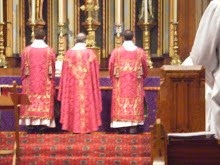
Second, consider the nature of ritual aesthetics. Anglo-Catholics have always been clear that it points to a theological truth. Thus the idea of aesthetics being separable from theology is an artificial one to begin with. A "Forward in Faith" Anglo-Catholic may disagree with an "affirming" Anglo-Catholic priest's views on orders or marriage, but when he (or she) dons a chasuble, he is saying something about our faith in the Eucharist - something that our hypothetical FiF observer should find quite familiar - and not merely making a fashion statement. Even female priests, who obviously dissent from FiF's position that they are Teflon-coated for sacramental insulation, should not be assumed to have a Eucharistic theology that is indebted in any substantial way to the Reformation. (One English correspondent whose opposition to WO was not of the "impossibilist" variety complained to me that he had never heard a woman priest chant the Preface. Perhaps this is a pond difference, but my first Anglican parish - on the high end of MOTR by Canadian standards, but what most in the CoE would call "high" - had a female incumbent who unfailingly chanted the preface unless on the verge of laryngitis).
Third, consider the ecclesiology of Forward in Faith. If as is undoubtedly the case the Catholic Faith consists not only in aesthetics but also in the deeper truths they represent, surely one of those truths is that of the nature of the church. Yet in England, with the adoption of provincial episcopi vagantes, "traditional" (read, biological-determinist) Anglo-Catholic parishes, in order to preserve their gin-and-lace ghetto and Y-chromosomal understanding of the priesthood, have sacrificed almost entire the corpus of Catholic teaching on the episcopate. The "Bishop" of Fulham, for example, is not a bishop in any recognizable catholic sense, with no see and no presbyterium of his own. (A makeshift presbyterium is nonetheless often corralled, with faux Chrism Masses drawing crowds of Anglo-Catholics dissatisfied with the real one, and the PEV concelebrating with those under his pastoral care as if a diocese).
Despite our differences then on the question of who may receive the sacraments of vocation, we have broad areas of convergence, and both groups (or tendencies) have made concessions in order to carry on our life of prayer and faith as best we can under present circumstances. Forward in Faith, however, has sought friendly relations with groups such as Reform (most of whom likely to don't even know what a sacrament of vocation is, much less believe in their status as such), describing catholics and evangelicals as two sides of one "orthodox" coin. Thus, while AffCaths (who apart from women and gays are indistinguishable from FiF) are written off as "Protestants in fancy dress," actual Protestants are welcomed with open arms as comrades in the orthodox and apostolic faith!
There are, I think, several problems with this analysis. It is clear that those Anglo-Catholics of a conservative persuasion regard new theologies of gender as an unjustifiable departure from Catholic Tradition. Moreover, they tend to be convinced of the "package deal" nature of Catholicism. However, while the Catholic Faith is certainly not an à la carte affair, it is difficult to see that "liberal" Anglo-Catholics are markedly less consistent in their approach than their "FiF" brethren, much less their Roman Catholic counterparts. (At first glance, it is vexing that Anglicans are vetted individually for catholicity while Roman Catholics are more or less given carte blance by virtue of their submission to Rome. However, the relationship between FiF and Rome is somewhat more nuanced. Despite recent enthusiasm for reunion, many who have gone before have been disappointed to find a church just as troubled as our own, and not a kitsch-free lace and incense paradise).
First, consider what "affirming" Catholics actually believe. The beliefs of these Anglicans about the Eucharist, and about the ministry and sacraments in general, is unrecognizable to Protestants, yet highly similar to that of Forward in Faith! In the Diocese of Toronto, where only one parish offers regular Evensong & Benediction, those who seek the Lord in his Eucharistic presence gather for devotion to express a common faith, whatever their disagreements on the qualifications for Eucharistic presidency. I may disagree with some Anglo-Catholics about whether a woman can be celebrate Mass, but my understanding of what happens when she does so comes straight from the Council of Trent.
Second, consider the nature of ritual aesthetics. Anglo-Catholics have always been clear that it points to a theological truth. Thus the idea of aesthetics being separable from theology is an artificial one to begin with. A "Forward in Faith" Anglo-Catholic may disagree with an "affirming" Anglo-Catholic priest's views on orders or marriage, but when he (or she) dons a chasuble, he is saying something about our faith in the Eucharist - something that our hypothetical FiF observer should find quite familiar - and not merely making a fashion statement. Even female priests, who obviously dissent from FiF's position that they are Teflon-coated for sacramental insulation, should not be assumed to have a Eucharistic theology that is indebted in any substantial way to the Reformation. (One English correspondent whose opposition to WO was not of the "impossibilist" variety complained to me that he had never heard a woman priest chant the Preface. Perhaps this is a pond difference, but my first Anglican parish - on the high end of MOTR by Canadian standards, but what most in the CoE would call "high" - had a female incumbent who unfailingly chanted the preface unless on the verge of laryngitis).
Third, consider the ecclesiology of Forward in Faith. If as is undoubtedly the case the Catholic Faith consists not only in aesthetics but also in the deeper truths they represent, surely one of those truths is that of the nature of the church. Yet in England, with the adoption of provincial episcopi vagantes, "traditional" (read, biological-determinist) Anglo-Catholic parishes, in order to preserve their gin-and-lace ghetto and Y-chromosomal understanding of the priesthood, have sacrificed almost entire the corpus of Catholic teaching on the episcopate. The "Bishop" of Fulham, for example, is not a bishop in any recognizable catholic sense, with no see and no presbyterium of his own. (A makeshift presbyterium is nonetheless often corralled, with faux Chrism Masses drawing crowds of Anglo-Catholics dissatisfied with the real one, and the PEV concelebrating with those under his pastoral care as if a diocese).
Despite our differences then on the question of who may receive the sacraments of vocation, we have broad areas of convergence, and both groups (or tendencies) have made concessions in order to carry on our life of prayer and faith as best we can under present circumstances. Forward in Faith, however, has sought friendly relations with groups such as Reform (most of whom likely to don't even know what a sacrament of vocation is, much less believe in their status as such), describing catholics and evangelicals as two sides of one "orthodox" coin. Thus, while AffCaths (who apart from women and gays are indistinguishable from FiF) are written off as "Protestants in fancy dress," actual Protestants are welcomed with open arms as comrades in the orthodox and apostolic faith!
Thursday, May 6, 2010
Election recap: NI
In Northern Ireland, the Alliance Party unseats Democratic Unionist First Minister Peter Robinson to win its first seat in the House of Commons in a general election, while Lady Hermon, previously the lone Ulster Unionist MP, wins re-election as a newly-minted independent after refusing to stand with the Ulster Conservatives and Unionists joint slate. The Social Democratic & Labour Party's leader is elected, while the Traditional Unionist Voice fails to make any inroads and the UCU are shut out. Volatile Fermanagh South Tyone faces a recount after the bipartisan Unionist candidate appears to win by a single-figure margin.
Subscribe to:
Posts (Atom)