Controversy is brewing over a ban on gay-straight alliances in the Halton Catholic District School Board. Along with Nazi groups and others in conflict with Catholic doctrine, GSAs are out because school authorities do not want to encourage kids to identify based on their sexual orientation. "I've never been to a GSA," one trustee told Xtra, "...They force people to be labelled as gay." If she had ever been to a GSA meeting, or you know, read its name in print, she would know that their mandate is to provide a safe space where students can congregate without being called upon to identify which part of the initialism they fall on, but we must assume in charity that the good Catholic woman was simply too flustered once "Gay" was on the brain to read the "straight alliance" bit for comprehension. Her characterization of GSAs as "sex clubs" further confirms the hunch that the bogey man the trustee imagines herself to be arguing against bears little resemblance the hapless group of kids back in reality who her policies are victimizing. Personally, I recall large numbers of Tim Horton's cookies consumed over fairly benign after-school conversation some of us might never have otherwise had the ability to do, and the occasional field trip into the city to hear a speaker. "Why can't heterosexual students have a club?" Xtra's source asks. But as every child learns on Mothers' and Fathers' Day and every white person come February, the answer to that question is inevitable: those would be every club in the student handbook.
The Catechism of the Catholic Church takes pains to preface and qualify its opposition to gay families with the proviso that "Every sign of unjust discrimination in their regard should be avoided." The trick, of course, is "unjust" - for subsequent actions make it clear that the Church's definition of "unjust" is sufficiently restrictive as to be meaningless. Apart from GSAs, developments the Church has fought as unacceptable waterings down of family teaching are:
*laws that guarantee the same rights to housing and employment as enjoyed by heterosexuals, so that a gay tenant could not be denied a lease on the basis of their sexual orientation - even if he is fully compliant with the Church's teaching on the expression of the same! Here the bishop argued that such laws could give credence to morality of homosexual relationships. Like the Halton boards, this case belied the Catechism's claim to be content with upholding the Church's understanding of marriage - rather, it is necessary to avoid any action that the faithful might misinterpret as in any way attributing humanity to gay people. Only life as single, homeless, unemployed drifters befits our wretched estate. It's hardly as if anyone is going to be under any illusions about the RC doctrine, so literally pulling the front doormat out from under our feet is above and beyond the call of "apostolic authority" and skirting petty-vindictive territory.
*the placement of children with adoptive parents of the same gender, so that a child unable to find a home can be bounced from one foster home to another throughout adolescence until they graduate to juvenile detention, but will at least be spared the affront to their dignity of being given to loving parents whose junk didn't match.
*the burial by Catholic families of their gay members. In this case, the bishop interfered with the parish priest's duty to minister to the family in its time of - hardly within the ambit of a bishop's power of "Godly admonition" - because the man in question owned a gay dance club. This case too is purely vindictive and groundless even assuming the RC model of moral theology. The funeral was denied because the man's business contradicted Catholic teaching, which apparently His Excellency has extended (by what authority?) to cover dancing, and allowing it to proceed would run the risk of the sin of "scandal." Treating the creation of scandal itself as a sin is a dangerous game. One confessional manual I read advised against allowing non-communicants to approach the altar for a blessing lest the good but clearly rather dim faithful wonder whether he received.
Now, our grandmothers and anyone whose common sense hasn't been eliminated by years of canon law training would know that the obvious answer to that is "Eyes on your own page!" If the laic is indeed so dimwitted as to be unable to imagine a non-nefarious explanation for what he witnesses, it is nevertheless none of his beeswax and the sin of scandal is commissioned by his making it so. Indeed, in some circumstances non-Catholics, even "open" (!) ones, are permitted not only to approach but to receive (e.g. in France). Does recourse to this legitimate canonical provision become sinful because a backseat canonist may second-guess whether the priest availed himself of it correctly? Likewise, the pastoral propriety of a given Christian burial cannot be subjected to a vote of clucking tongues in the CWL. Besides all of which, you would think such a grievous sinner would need the Church's navigational assistance more than ever at such a critical soteriological moment as death. And when you consider the importance of funerals not just to the departed soul but to the family, the whole enterprise becomes even sillier. To bury someone is not to endorse his "lifestyle" but to offer the prayers which are due for all the departed, and bereavement is not a time to be hijacked by the curia to make a polemical point which Martians would have to be deaf not to have gotten by this point.
So the Roman Catholic position on homosexuality is in no way an attack on the dignity of the gay person himself, unless your idea of dignity includes things like a roof over your head. And this is not purely an academic point, for it goes straight to the credibility of the Church's claim that it is "catholic" - open to all people. If the gay person who assiduously observes the RCC's marital discipline is still not worthy of food or shelter, then it's clear that the Church does not merely subject gay relationships to the same disciplinary considerations as other irregular relationships, but in fact does precisely what it claims not to: demonize homosexuals as such, regardless of their moral valour. And then, when gay teens started dropping like flies those few awful weeks last fall, numerous Christians insisted to me that Christianity was not to blame as it had always limited its condemnation to the sin and not the sinner. I assume these people, however, consider eating and sleeping in a bed to be basic rights rather than sins, so unless they imagine that gays have some special perverted way of eating, it is clear that their desire to limit the rhetoric on the record takes considerable liberties with the history.
Wednesday, January 12, 2011

Wednesday, December 22, 2010
TRM Ordo Winter 2011
January
1- The Octave Day of Christmas, being the Naming & Circumcision of Jesus (white, BAS p. 277, Gradual 1113)
2- SECOND SUNDAY OF CHRISTMAS (white, BAS p. 278, Gradual 1116)
3- St Basil the Great and St Gregory of Nazianzus (white or yellow, BAS p. 456, FAtS p. 40, Gradual 2366 or 2259)
4- Requiem (black, BAS p. 456, Gradual 4730)
5- Requiem (black, BAS p. 457)
6- Epiphany of the Lord (white, BAS p. 279, Gradual 1202)
7- In the Octave of the Epiphany (white, BAS p. 457)
8- In the Octave of the Epiphany (white, BAS p. 457); Vigil of the Baptism of the Lord (Gradual 1204)
9- BAPTISM OF THE LORD (white, BAS p. 348, Gradual 1205)
10- in the Octave comm. William Laud (white, BAS p. 468, FAtS p. 44, Gradual 2032)
11- Holy Innocents , comm. Octave (purple or red, BAS p. 398, Gradual 1108)
12- in the Octave, comm. Marguerite Bourgeoys (white, BAS p. 468, FAtS p. 48, Gradual 3412)
13- Octave Day of the Epiphany, comm. St Hilary of Poitiers (white, BAS p. 468, FAtS p. 52, Gradual 2036)
14- John Horden (white, BAS p. 469, FAtS p. 50, Gradual 3121)
15- Richard Meux Benson, (white, BAS p. 469, FAtS p. 54, Gradual 3411)
16- SECOND SUNDAY AFTER EPIPHANY (white, BAS p. 349, Gradual 1303)
17- St Antony of Egypt (white, BAS p. 469, FAtS p.56, Gradual 2042)
18- Confession of St Peter the Apostle (red, BAS p. 399, Gradual 2044), comm. Holy Innocents Octave of Christian Unity begins
19- Requiem (black, BAS p. 469)
20- Requiem (black, BAS p. 469)
21- St Agnes of Rome(red, BAS . 469, FAtS p. 60, Gradual 2050)
22- St Vincent of Saragossa (red, BAS p. 469, FAtS p. 462, Gradual 2052)
23- THIRD SUNDAY AFTER EPIPHANY, (white, BAS p. 350, Gradual 1304)
24- St Francis de Sales (white or yellow, BAS p. 470, FAtS p. 64, Gradual 3211)
25- Conversion of St Paul (red, BAS p. 400, Gradual 2056)
26- Ss. Timothy and Titus (red, BAS p. 470, FAtS p. 68, Gradual 2060)
27- St John Chrysostom (white, BAS p. 470, FAtS p. 70, Gradual 2062)
28- St Thomas Aquinas (white, BAS p. 470, FAtS p. 72, Gradual 2064)
29- Our Lady on Saturday (white and blue, BAS p. 470, Gradual 5574)
30- FOURTH SUNDAY AFTER EPIPHANY (white, BAS p. 352, Gradual 1305)
31- St Charles Stuart (red, BAS p. 470, FAtS p. 74, Gradual 2066)
February
1- Requiem (BAS p. 470)
2- The Presentation of the Lord and Purification of the Blessed Virgin, commonly called Candlemas (white, BAS p. 401, Gradual 2070)
3- St Anskar, Apostle of the North (red, BAS p. 470, FAtS p. 78, Gradual 2072)
4- Requiem (BAS p. 470)
5- Holy Martyrs of Japan (red, BAS p. 470, FAtS p. 80, Gradual 2076)
6- FIFTH SUNDAY AFTER EPIPHANY (green, BAS p.353, Gradual 1306); at the office Accession Day (BCP p. xlviii)
7- Requiem (BAS p.4 70)
8- Requiem
9- Hannah Grier Coome (white, BAS p. 470, FAtS p. 82, Gradual 3412)
10- Requiem (BAS p. 471)
11- Requiem
12- Our Lady on Saturday (BAS p. 471)
13- SIXTH SUNDAY AFTER EPIPHANY (green, BAS p. 354, Gradual 1307)
14- Sts Cyril & Methodius, Apotles to the Slavs (red, BAS p. 472, FAtS p. 84, Gradual 2084)
15- Thomas Bray (white, BAS p. 472, FAtS p. 86, Gradual 2086)
16-18 Requiem (BAS p. 472)
19- Our Lady on Saturday (BAS p. 472)
20- SEVENTH SUNDAY AFTER EPIPHANY (green, BAS p.356, Gradual 1308)
21- Requiem (BAS p.473)
22- Requiem
23- St Polycarp of Smyrna (red, BAS p. 473, FAtS p. 88, Gradual 2088)
24- Philip Lindel Tsen (red, BAS p. 473, FAtS p. 90, Gradual 3011)
25- Paul Sasaki (red, BAS p. 474, FAtS p. 92, Gradual 3012)
26- Our Lady on Saturday (BAS p. 474)
27- EIGTHTH SUNDAY AFTER EPIPHANY (green, BAS p. 357, Gradual 1309)
28- George Herbert (white, BAS p. 475, FAtS p. 94, Gradual 2092)
March
1-St David of Wales (white or yellow, BAS p. 475, FAtS p. 96, Gradual 2093)
2-St Chad of Lichfield (white or yellow, BAS p. 475, FAtS p. 98, Gradual 2094)
3-John and Charles Wesley (white, BAS p. 475, FAtS p. 100, Gradual 2095)
4- Requiem (BAS p. 475)
5- Our Lady on Saturday
6- LAST SUNDAY AFTER EPIPHANY (white, BAS p. 357 & 418, Gradual 1310)
7 – St Perpetua of Carthage & Companions (red, BAS p. 458, FAtS p 102, Gradual 2097)
8 – Edward King, (white or yellow, BAS p. 458, FAtS p. 104, Gradual 3211)
9 – Ash Wednesday (purple, BAS p. 281, Gradual 1403)
1- The Octave Day of Christmas, being the Naming & Circumcision of Jesus (white, BAS p. 277, Gradual 1113)
2- SECOND SUNDAY OF CHRISTMAS (white, BAS p. 278, Gradual 1116)
3- St Basil the Great and St Gregory of Nazianzus (white or yellow, BAS p. 456, FAtS p. 40, Gradual 2366 or 2259)
4- Requiem (black, BAS p. 456, Gradual 4730)
5- Requiem (black, BAS p. 457)
6- Epiphany of the Lord (white, BAS p. 279, Gradual 1202)
7- In the Octave of the Epiphany (white, BAS p. 457)
8- In the Octave of the Epiphany (white, BAS p. 457); Vigil of the Baptism of the Lord (Gradual 1204)
9- BAPTISM OF THE LORD (white, BAS p. 348, Gradual 1205)
10- in the Octave comm. William Laud (white, BAS p. 468, FAtS p. 44, Gradual 2032)
11- Holy Innocents , comm. Octave (purple or red, BAS p. 398, Gradual 1108)
12- in the Octave, comm. Marguerite Bourgeoys (white, BAS p. 468, FAtS p. 48, Gradual 3412)
13- Octave Day of the Epiphany, comm. St Hilary of Poitiers (white, BAS p. 468, FAtS p. 52, Gradual 2036)
14- John Horden (white, BAS p. 469, FAtS p. 50, Gradual 3121)
15- Richard Meux Benson, (white, BAS p. 469, FAtS p. 54, Gradual 3411)
16- SECOND SUNDAY AFTER EPIPHANY (white, BAS p. 349, Gradual 1303)
17- St Antony of Egypt (white, BAS p. 469, FAtS p.56, Gradual 2042)
18- Confession of St Peter the Apostle (red, BAS p. 399, Gradual 2044), comm. Holy Innocents Octave of Christian Unity begins
19- Requiem (black, BAS p. 469)
20- Requiem (black, BAS p. 469)
21- St Agnes of Rome(red, BAS . 469, FAtS p. 60, Gradual 2050)
22- St Vincent of Saragossa (red, BAS p. 469, FAtS p. 462, Gradual 2052)
23- THIRD SUNDAY AFTER EPIPHANY, (white, BAS p. 350, Gradual 1304)
24- St Francis de Sales (white or yellow, BAS p. 470, FAtS p. 64, Gradual 3211)
25- Conversion of St Paul (red, BAS p. 400, Gradual 2056)
26- Ss. Timothy and Titus (red, BAS p. 470, FAtS p. 68, Gradual 2060)
27- St John Chrysostom (white, BAS p. 470, FAtS p. 70, Gradual 2062)
28- St Thomas Aquinas (white, BAS p. 470, FAtS p. 72, Gradual 2064)
29- Our Lady on Saturday (white and blue, BAS p. 470, Gradual 5574)
30- FOURTH SUNDAY AFTER EPIPHANY (white, BAS p. 352, Gradual 1305)
31- St Charles Stuart (red, BAS p. 470, FAtS p. 74, Gradual 2066)
February
1- Requiem (BAS p. 470)
2- The Presentation of the Lord and Purification of the Blessed Virgin, commonly called Candlemas (white, BAS p. 401, Gradual 2070)
3- St Anskar, Apostle of the North (red, BAS p. 470, FAtS p. 78, Gradual 2072)
4- Requiem (BAS p. 470)
5- Holy Martyrs of Japan (red, BAS p. 470, FAtS p. 80, Gradual 2076)
6- FIFTH SUNDAY AFTER EPIPHANY (green, BAS p.353, Gradual 1306); at the office Accession Day (BCP p. xlviii)
7- Requiem (BAS p.4 70)
8- Requiem
9- Hannah Grier Coome (white, BAS p. 470, FAtS p. 82, Gradual 3412)
10- Requiem (BAS p. 471)
11- Requiem
12- Our Lady on Saturday (BAS p. 471)
13- SIXTH SUNDAY AFTER EPIPHANY (green, BAS p. 354, Gradual 1307)
14- Sts Cyril & Methodius, Apotles to the Slavs (red, BAS p. 472, FAtS p. 84, Gradual 2084)
15- Thomas Bray (white, BAS p. 472, FAtS p. 86, Gradual 2086)
16-18 Requiem (BAS p. 472)
19- Our Lady on Saturday (BAS p. 472)
20- SEVENTH SUNDAY AFTER EPIPHANY (green, BAS p.356, Gradual 1308)
21- Requiem (BAS p.473)
22- Requiem
23- St Polycarp of Smyrna (red, BAS p. 473, FAtS p. 88, Gradual 2088)
24- Philip Lindel Tsen (red, BAS p. 473, FAtS p. 90, Gradual 3011)
25- Paul Sasaki (red, BAS p. 474, FAtS p. 92, Gradual 3012)
26- Our Lady on Saturday (BAS p. 474)
27- EIGTHTH SUNDAY AFTER EPIPHANY (green, BAS p. 357, Gradual 1309)
28- George Herbert (white, BAS p. 475, FAtS p. 94, Gradual 2092)
March
1-St David of Wales (white or yellow, BAS p. 475, FAtS p. 96, Gradual 2093)
2-St Chad of Lichfield (white or yellow, BAS p. 475, FAtS p. 98, Gradual 2094)
3-John and Charles Wesley (white, BAS p. 475, FAtS p. 100, Gradual 2095)
4- Requiem (BAS p. 475)
5- Our Lady on Saturday
6- LAST SUNDAY AFTER EPIPHANY (white, BAS p. 357 & 418, Gradual 1310)
7 – St Perpetua of Carthage & Companions (red, BAS p. 458, FAtS p 102, Gradual 2097)
8 – Edward King, (white or yellow, BAS p. 458, FAtS p. 104, Gradual 3211)
9 – Ash Wednesday (purple, BAS p. 281, Gradual 1403)
Monday, December 20, 2010
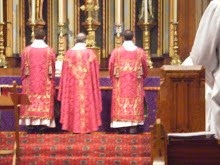
Gaudete!
 (Photo: Anglican Ex Fide)
Blessed are you, O Divine Light, herald of the dawn and the doom. In the beginning, God said, Be! and you were chosen to be the first to obey the source of all. In these last days, you return to us to search out all hearts in your inescapable splendour. Come and inflame our hearts with longing for your reappearing. Let all the creatures of the Thrice-Holy say Amen!
Sunday, November 28, 2010
Further glimpses of Toronto of old, courtesy of The Star
 An early outpost of the Reformed Episcopal Church advertises services "for Low Churchmen" on Easter Day, 1921
Liberal Catholic Easter notice for Procession, Solemn Eucharist, and Benediction from 1936. (The lot in question is now "Trainers Fitness" just south of Honest Ed's).

Advertisement from St Bart's for the Feast of Dedication the year of Fr Pashler's death, 1959, with notice of the Induction of Fr Belway.

An early Old Catholic mission in Toronto under Abp Grosvold. The dedication suggests a gay-oriented congregation but no direct connection with the present-day Eucharistic Catholic Church in Cabbagetown.


This notice from 1975 (left) shows that St Mary Magdalene had shed its earlier reticent terminology of "Solemn Eucharist", "Devotions," etc and nailed its "Old Western Rite" colours to the mast. By the Garnsworthy years (right), the Papalism of the parish is in full bloom (note "Vespers").
 SSPX advertisement for Corpus Christi from the late 1990s.
Tuesday, November 23, 2010
The English Missal in Pictures
Solemn Mass with the Society of Catholic Priests at Trinity College Chapel, Monday 22 November, in the week of the Reign of Christ.


Monday, November 22, 2010
Some responses to Citizens for a Canadian Republic
Unpublished remarks I wrote on Citizens for a Canadian republic as expressed in its statements.
***
Inherited rights in government, symbolic or otherwise, is a concept incompatible with Canadian values of egalitarianism.
A Canadianized head of state should be the embodiment of Canadian sovereignty, diversity and pride - a position to which all Canadians could aspire.
This seems to be the crux of most opposition to monarchy and it rests on a misunderstanding of what a head of state is and does. The Queen has not inherited a position of privilege or any “special” rights. Under our constitution she fulfils certain roles as head of state - roles that would have to be filled by someone anyway. Historical providence has provided us with a means of selecting a politically-neutral “referee” who can uphold the constitution without having to bend to political pressure. Being head of state should not be the end of a political career ladder, nor is the nature of the office such that it is something that in principle must be open to all applicants. It is more important that the function be done than who does it.
It should also be said that the “Canadian values of egalitarianism” are enshrined in laws which the Queen herself has signed into law. This reflects the nature of the Canadian Crown, which does not act unilaterally but only to give force to the will of the people, and thus enacts the laws that we ourselves have mandated our elected representatives to pass. Likewise, while vested with the authority to appoint the prime minister, the sovereign uses this power to designate the leader of the party that has won the election rather than to parachute in her own preferred candidate.
Our head of state should be a true representative of the People of Canada. Presently, the Queen does not represent Canada when she travels abroad and we think that’s not in our best interest...
The act of attaining full-fledged status as a democratic republic within the Commonwealth would be the completion of a process of independence that began over a century ago.
Canada became fully independent in 1931 except by request with respect to constitutional amendment (until 1982) and the judiciary (1949). Because our Dominion and provincial governments could not agree on a formula for amending the constitution, Canada retained the rubber-stamp of the British Parliament for constitutional amendments. This was resolved in 1982, since which time our independence has been “complete.” Transition to a republic would not make us any more “full-fledged” a member of the Commonwealth - if anything the opposite!
That several other countries, including the United Kingdom and Jamaica, have the same relationship with the Queen that we do is a matter of historical circumstance. It is thus understandable that she cannot always be representing any one country. Each realm’s Governor General acts as her full-time delegate for that country and Canadians are hardly deprived of executive representation abroad.
Canada’s head of state should be a Canadian citizen and not be above our laws. Presently, the Act of Settlement of 1701 constitutionally binds Canada to only heads of state who are not Roman Catholics. They must also be required to hold the position of Supreme Governor of The Church of England, thereby also preventing, Jews, Hindus, Muslims or anyone not a member of that Protestant denomination from becoming Canada’s head of state. Section 15(1) of Canada’s Charter of Rights and Freedoms expressly forbids discrimination on the basis of "race, national or ethnic origin, colour, religion, sex, age or mental or physical disability".
First, the assumption that “Canada’s head of state should be a Canadian citizen” is a confusion. The Queen is not a citizen because she is head of state, but that does not mean she is not Canadian. She does not hold a Canadian (or British) passport; they are issued in her name. She does not share our citizenship because she is the fount from which it flows.
The historical factors that led to the passage of the Act of Settlement are varied and complex, and only incidentally about religion. Ironically and presumably unbeknownst to the republicans who attack it, it was in its day a victory for the forces of parliamentary democracy over absolute monarchy. Requiring the monarch to be a member of the national churches was just one way of ensuring Britain’s independence from foreign interference at a time when the Papacy was much more like a monarchy itself. Although the Act of Settlement is itself a part of our Canadian constitutional law, some would argue that it has outlived its usefulness. In the Church of England itself, there is increasing support for disestablishment and the end of a governmental role in church affairs. In any case, the Act of Settlement can be amended without abolishing our system of constitutional monarchy.
Canadians increasingly want to address the so-called "democratic deficit" that’s prevalent in Canada’s political system. In every good democracy, there’s a solid framework of checks and balances to ensure against the proliferation of abuses. One way to address that would be to have an elected head of state (either by the public, parliament or other such body), not an appointed Governor General who is simply the deputy of a distant monarch, chosen personally by the Prime Minister.
The Crown is one of the best safeguards against abuses of power in our constituonal arsenal, and the checks and balances it provides would, on the contrary, be threatened by a republic. A private citizen who became head of state would bring her own political biases to bear. She might exercise the power of veto to prevent bills with which she disagreed from becoming law. Because the Queen’s powers are to be used only to defend the people’s democratic will, she does not override laws passed by our elected representatives. In Canada, for example, Conservative politicans have campaigned against same-sex marriage. In the United Kingdom, the Queen signed the Civil Partnership Act 2004 into law though she is said to be quite conservative on the subject in private. Would Stephen Harper have done the same thing? Canadians can be confident that no matter what their background or station in life, the Queen is a head of state of all of us, and not just those of her race or economic class.
To take another example from the current government, a great deal of controversy arose over the prime minister’s use of prorogation to avoid a finding of contempt of parliament. While the Governor General’s failure to intervene in this case is regrettable, it is an illustration of what the Crown is there to do for Canadians. An apolitical head of state chosen purely by historical and genetic accident can refuse a request for prorogation if it is deemed to be an attempt to thwart the will of the people.
New Canadians should not be subjected to swearing an oath to a monarch who not only isn’t a Canadian citizen herself, but also, in some cases, represents many aspects of what prospective citizens are trying to leave behind. They’re coming to Canada to embrace a way of life that emphasizes equality and the rights of the individual, not peerage, royalty and classism.
The oath to the Queen is sworn because she is the ceremonial embodiment of Canada. We do not pledge to till her fields as vassals. Republics have to find other “personifications” such as the quasi-idolatrous “Pledge of Allegiance” to the American flag. Despite her relative (and often overstated) affluence, the Queen is not an enemy of the working class or a drain on the wallets of Canadians. The cost of her maintenance is less than that of many other heads of state and pales in comparison to the revenue her estates create for public benefit.
The Canadian way of life to which CCR refers is one that we have managed to establish quite successfully within our current system. The Charter of Rights and Freedoms, the most important expression of our values of individual rights and equality, is without parallel in the republic south of our border. The burden of proof is on republicans to show how those achievements are detracted by the monarchy or could be improved by an elected president.
... one thing that unites republicans throughout the Commonwealth is the belief that the transition will most easily be done by evolving the present Westminster-style parliamentary monarchies into Westminster-style parliamentary republics. This would retain a largely ceremonial, politically-neutral and symbolic head of state as president (with some reserve powers for special circumstances) and a prime minister as head of government.
... with the exception of being the representative of the People of Canada rather than the Crown, it's possible - perhaps even likely - that the functional change will barely be noticeable to most Canadians.
In other words, CCR doesn’t have a problem with what the Queen does per se; they just think it should be done by someone elected, but don’t really want to change the nature of the office itself By their own admission, the years of constitutional overhaul they propose would not change very much. It is unclear then how our society would be more free or just simply by changing the means of selecting the head of state. If anything, an elected head of state would be less effective as a democratic “referee” since he would be accountable only to that portion of the populace to which he owes his election.
***
Inherited rights in government, symbolic or otherwise, is a concept incompatible with Canadian values of egalitarianism.
A Canadianized head of state should be the embodiment of Canadian sovereignty, diversity and pride - a position to which all Canadians could aspire.
This seems to be the crux of most opposition to monarchy and it rests on a misunderstanding of what a head of state is and does. The Queen has not inherited a position of privilege or any “special” rights. Under our constitution she fulfils certain roles as head of state - roles that would have to be filled by someone anyway. Historical providence has provided us with a means of selecting a politically-neutral “referee” who can uphold the constitution without having to bend to political pressure. Being head of state should not be the end of a political career ladder, nor is the nature of the office such that it is something that in principle must be open to all applicants. It is more important that the function be done than who does it.
It should also be said that the “Canadian values of egalitarianism” are enshrined in laws which the Queen herself has signed into law. This reflects the nature of the Canadian Crown, which does not act unilaterally but only to give force to the will of the people, and thus enacts the laws that we ourselves have mandated our elected representatives to pass. Likewise, while vested with the authority to appoint the prime minister, the sovereign uses this power to designate the leader of the party that has won the election rather than to parachute in her own preferred candidate.
Our head of state should be a true representative of the People of Canada. Presently, the Queen does not represent Canada when she travels abroad and we think that’s not in our best interest...
The act of attaining full-fledged status as a democratic republic within the Commonwealth would be the completion of a process of independence that began over a century ago.
Canada became fully independent in 1931 except by request with respect to constitutional amendment (until 1982) and the judiciary (1949). Because our Dominion and provincial governments could not agree on a formula for amending the constitution, Canada retained the rubber-stamp of the British Parliament for constitutional amendments. This was resolved in 1982, since which time our independence has been “complete.” Transition to a republic would not make us any more “full-fledged” a member of the Commonwealth - if anything the opposite!
That several other countries, including the United Kingdom and Jamaica, have the same relationship with the Queen that we do is a matter of historical circumstance. It is thus understandable that she cannot always be representing any one country. Each realm’s Governor General acts as her full-time delegate for that country and Canadians are hardly deprived of executive representation abroad.
Canada’s head of state should be a Canadian citizen and not be above our laws. Presently, the Act of Settlement of 1701 constitutionally binds Canada to only heads of state who are not Roman Catholics. They must also be required to hold the position of Supreme Governor of The Church of England, thereby also preventing, Jews, Hindus, Muslims or anyone not a member of that Protestant denomination from becoming Canada’s head of state. Section 15(1) of Canada’s Charter of Rights and Freedoms expressly forbids discrimination on the basis of "race, national or ethnic origin, colour, religion, sex, age or mental or physical disability".
First, the assumption that “Canada’s head of state should be a Canadian citizen” is a confusion. The Queen is not a citizen because she is head of state, but that does not mean she is not Canadian. She does not hold a Canadian (or British) passport; they are issued in her name. She does not share our citizenship because she is the fount from which it flows.
The historical factors that led to the passage of the Act of Settlement are varied and complex, and only incidentally about religion. Ironically and presumably unbeknownst to the republicans who attack it, it was in its day a victory for the forces of parliamentary democracy over absolute monarchy. Requiring the monarch to be a member of the national churches was just one way of ensuring Britain’s independence from foreign interference at a time when the Papacy was much more like a monarchy itself. Although the Act of Settlement is itself a part of our Canadian constitutional law, some would argue that it has outlived its usefulness. In the Church of England itself, there is increasing support for disestablishment and the end of a governmental role in church affairs. In any case, the Act of Settlement can be amended without abolishing our system of constitutional monarchy.
Canadians increasingly want to address the so-called "democratic deficit" that’s prevalent in Canada’s political system. In every good democracy, there’s a solid framework of checks and balances to ensure against the proliferation of abuses. One way to address that would be to have an elected head of state (either by the public, parliament or other such body), not an appointed Governor General who is simply the deputy of a distant monarch, chosen personally by the Prime Minister.
The Crown is one of the best safeguards against abuses of power in our constituonal arsenal, and the checks and balances it provides would, on the contrary, be threatened by a republic. A private citizen who became head of state would bring her own political biases to bear. She might exercise the power of veto to prevent bills with which she disagreed from becoming law. Because the Queen’s powers are to be used only to defend the people’s democratic will, she does not override laws passed by our elected representatives. In Canada, for example, Conservative politicans have campaigned against same-sex marriage. In the United Kingdom, the Queen signed the Civil Partnership Act 2004 into law though she is said to be quite conservative on the subject in private. Would Stephen Harper have done the same thing? Canadians can be confident that no matter what their background or station in life, the Queen is a head of state of all of us, and not just those of her race or economic class.
To take another example from the current government, a great deal of controversy arose over the prime minister’s use of prorogation to avoid a finding of contempt of parliament. While the Governor General’s failure to intervene in this case is regrettable, it is an illustration of what the Crown is there to do for Canadians. An apolitical head of state chosen purely by historical and genetic accident can refuse a request for prorogation if it is deemed to be an attempt to thwart the will of the people.
New Canadians should not be subjected to swearing an oath to a monarch who not only isn’t a Canadian citizen herself, but also, in some cases, represents many aspects of what prospective citizens are trying to leave behind. They’re coming to Canada to embrace a way of life that emphasizes equality and the rights of the individual, not peerage, royalty and classism.
The oath to the Queen is sworn because she is the ceremonial embodiment of Canada. We do not pledge to till her fields as vassals. Republics have to find other “personifications” such as the quasi-idolatrous “Pledge of Allegiance” to the American flag. Despite her relative (and often overstated) affluence, the Queen is not an enemy of the working class or a drain on the wallets of Canadians. The cost of her maintenance is less than that of many other heads of state and pales in comparison to the revenue her estates create for public benefit.
The Canadian way of life to which CCR refers is one that we have managed to establish quite successfully within our current system. The Charter of Rights and Freedoms, the most important expression of our values of individual rights and equality, is without parallel in the republic south of our border. The burden of proof is on republicans to show how those achievements are detracted by the monarchy or could be improved by an elected president.
... one thing that unites republicans throughout the Commonwealth is the belief that the transition will most easily be done by evolving the present Westminster-style parliamentary monarchies into Westminster-style parliamentary republics. This would retain a largely ceremonial, politically-neutral and symbolic head of state as president (with some reserve powers for special circumstances) and a prime minister as head of government.
... with the exception of being the representative of the People of Canada rather than the Crown, it's possible - perhaps even likely - that the functional change will barely be noticeable to most Canadians.
In other words, CCR doesn’t have a problem with what the Queen does per se; they just think it should be done by someone elected, but don’t really want to change the nature of the office itself By their own admission, the years of constitutional overhaul they propose would not change very much. It is unclear then how our society would be more free or just simply by changing the means of selecting the head of state. If anything, an elected head of state would be less effective as a democratic “referee” since he would be accountable only to that portion of the populace to which he owes his election.
Sunday, November 21, 2010
Passings

A brief note to acknowledge that at the Church of St John the Evangelist, Calgary's lone Anglo-Catholic parish, an "overwhelming" majority of parishioners approved a motion to seek entry into Canada's impending personal ordinariate in a special vestry meeting following today's High Mass. I've never had a chance to get out to Calgary but I always hoped to visit St John's when I do. I'm sorry that the diocese will no longer have that kind of Anglo-Catholic witness and that I won't be able to visit as a communicant one day.
I gather that the parish's situation was becoming difficult as a result of the prevailing view on the ordination of women as well as its use of the English Missal. (Interestingly, the honorary assistant, Canon Green SSC, banished the English Missal from the pews when he was our rector in the 80s - I say "our" anachronistically as I was neither yet alive nor an Anglican at the time!) In any case, I commend the people of the parish for having the integrity to follow through on their conviction in the Roman Catholic Church's claims about itself and remember them in prayer as they take this step. Pray too for those remaining in the Anglican Church of Canada to preserve its Catholic tradition from within.
Subscribe to:
Posts (Atom)