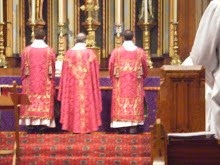
From John Ross Robertson's Sketches in City Churches (1886).

NO. 22. -CATHOLIC APOSTOLIC.
A CHURCH WITH CULTURE—A NOVEL AND BEAUTIFUL SERVICE CONDUCTED ACCORDING TO A RICH RITUAL—ITS DOCTRINES AND ORIGIN.
At the corner of Gould and Victoria streets stands a white brick church, with a well proportioned outline, surmounted with a very graceful spire. Aside from the handsome spire which gives dignity and beauty to the edifice there is nothing architecturally attractive about it. The building was originally owned by the St. James' Square Presbyterian church and was sold to its present owners a few years ago for $10,300. An arched doorway in the front, on Gould street, is reached by a flight of steps, the only entrance now used. Above it is a group of lancet, cathedral class windows, with a small "rose" window above, and still higher a stone on which is inscribed: "Christo, A.D. MDCCCLV." A small gallery above the vestibule accommodates the choir and contains an old-fashioned, yellow painted, ten-stop organ, but one whose appearance gives no evidence of the volume and harmony of sound it is capable of producing. The room will seat about 400 people and is very plain in its furnishing; the walls are stuccoed in stone colour, and the ceiling, supported by light trusses, is frescoed in panels. Three gasaliers hang from it, while in front of the altar a perpetual light is kept burning in honour of the Presence of God as symbolized in the eucharistic elements kept in the gold-lined tabernacle. Above the altar is a panelled space, whose background is blue, sprinkled with gilt stars, the arch of which is maintained by white columns. Above this arch and near the ceiling is a group of three cinque-foil windows.
A large section of the front part of the building, on the south, is set apart for the chancel, on either side of which is a dark wood partition, forming a passageway to the ante-rooms and robing rooms downstairs. Against the eastern wall, and entirely without the limits of the chancel, is a large circular enclosed pulpit; no railing divides the chancel from the main part of the room, but it is considered to be a very sacred place. When the reporter visited the building he was particularly cautioned not to set foot upon the highest of the four platforms because it is "holy;" even the caretaker does not go there for the purpose of cleaning and dusting; this work is only done by an official whose consecration gives him admission to the sacred precincts. On the main floor are small kneeling desks for the deacons present who and are habited with black cassocks and white surplices and whose duty it is to assist the priests during the service. On the first platform, about four inches from the floor are stations for the two elders or priests who assist the angel or bishop; here are also, on either side, reading desks, one the Epistle, and the other the Gospel. On the next platform are eight stalls for the nonofficiating priests and a high-backed oak chair for the bishop and a table for the eucharistic vessels. On the third elevation are simply hassocks and cushions used by the officiating bishop and priests while the fourth elevation contains the altar, a pretty but small piece of furniture made of black walnut with red and yellow ornamentation and the monogram J. H. S. inscribed.
The bishop's and other officials' robing rooms are in the basement, a rather dilapidated looking room with the old Presbyterian pulpit still standing. It seems to be in accordance with the tenets of the people worshipping in this church not to lay so much stress upon the outward building as upon the ritualism of worship and the special ornaments, vessels and robes used in the celebration of their services.
"What time do you have service on Sunday morning?" was asked one of the members.
"At half-past ten, sun time," was the reply; "we do not follow times and seasons that man has made; we go according to the time God has ordained, not according to man's changes. After dark then we go according to city time."
Accordingly, last Sunday morning a Telegram reporter entered the church for the purpose of acquainting himself with the method of worship that obtains here. Just within the door is a small wooden box containing a bowl of water into which every member dips his fingers and touches his forehead with it, sometimes making thereon the sign of the cross. Next to this bowl of water is a long narrow box divided into compartments for the reception of the offerings. No collections are taken in this church, but each member is expected to contribute one-tenth of what he earns during the week; if he earns $10 then he should give $1 to the church; if he earns $50 he should give $5, and so on. This part of his alms-giving goes into the "tithes" apartment, and whatever more he can contribute he may give to either the " poor fund," "evangelistic work" or "building fund." All the offerings are purely voluntary; no pews are rented and no assessment of any kind is levied.
In front of a large stone baptismal font and directly behind the pews are three stations for the black-robed under-deacons, whose business it is to supervise the seating and comfort of the congregation. About 150 people were present last Sunday morning; people of all ages from the old, whitehaired man, whose sun of life is very near its setting, down to the little child for whom life is just budding into beauty and joy. They were what would be termed of the middle-class of our city's population, and had the appearance of sober, earnest and discriminating intelligence. Their distinguishing characteristic was that of sincerity and reverence; although the service was longer than an hour and a half, there was not the slightest token of impatience or of indecorum; even the little children were worshipful, and it seemed as if some other than mere earthly influence kept the congregation so devout and respectful. Service is held Sunday morning at 10 o'clock and in the evening at 5 o'clock, and also every day at 6 a.m. and 5 p.m. On every Sunday morning the eucharistic service is held, the central and most significant of all services and one whose solemnity and cultivated ceremony are not surpassed by any other service in this city. After a brief preliminary service the consecrated elements are removed from the tabernacle of the altar by the celebrant, a bishop or angel, assisted by two priests or elders, and attended by five deacons; in slow and orderly procession these withdraw to the rooms below where the bread and wine are consumed. During their absence an organ voluntary was played; in ten minutes the procession returned, the bishop and priests having removed the plainer vestments and substituted very nice robes; there is no genuflection before the altar, but there is frequent bowing, and whenever in the service the name of Jesus is pronounced the officials and people always incline the head.
The ritual, while it is a composition of the most elegant portions of the Latin and Greek formulae, yet very closely follows that of the Church of England. The service is entirely choral and the responses and versicles, which are sung chiefly to Tallis' Church of England setting, are given, not by the choir only, but by the entire congregation and mainly without an organ accompaniment. The confession was said while the bishop faced the altar; it, as well as all the prayers and the absolution, were responded to by the congregation in choral unison; the bishop then turned and faced the people while he pronounced the absolution. The epistle was read by one of the priests, a young man, while the Gospel was read by Rev. Joseph Elwell, formerly a clergyman of the Episcopal church, who also pronounced a brief homily emphasizing the distinguishing features of this church, viz.: The guiding influence of the Holy Spirit and the second advent of Jesus Christ who is to come and set up a material kingdom in this world. The speaker, a whitehaired old man of patriarchal and dignified bearing, used no arts of oratory or diction; he spoke simply, plainly, sincerely and confidently. Indeed the
SERVICE WAS REMARKABLE
for a singular combination of this simple reverence and dignity with the most classical and cultured finish. It was so superfine in conception and so cultivated in execution, and had about it, by virtue of its simplicity, such a refining and uplifting and helpful spirit that no other service can possibly exceed it in these respects. And it was fertile of suggestion; the small company of the "sealed," as the members are called, and their positive conviction of the presence ot the Supernatural Comforter reminds one of that "little upper room" in Jerusalem where only the Master and the twelve communed. The table with its rich and chastely wrought silver service, covered with delicate white linen, the embellished robes of the priests, the perpetual fire before the altar, the rising cloud of perfumed incense wreathing a benediction above the Symbols of the Presence, the white-haired ministers, the simple pomp and dignity of it all — who is not reminded thereby of the tabernacle of the wilderness and the later glory of the golden-walled temple?
"Men amuse themselves with empty abstractions," said the homilist, and while all this ceremony, so beautiful and impressive, may be thought an abstraction by some it is a reality to these sincere people, because directly underneath it is the real living Presence of the Holy Spirit and these vestments and sweetly-smelling incense and emblems are simply the outward robes veiling a spiritual reality. Their faith in the sacrament is very strong, and they sometimes associate with its administration healing properties. One of the members assured the reporter that in a certain critical case when the patient was declared hopelessly ill by several physicians the sacrament was administered
in extremis and the patient recovered.
AN IMPRESSIVE RITUAL.
After the homily the people rose and recited the Nicene creed. When the words "He was made man" were said all heads were bowed and there was a pause of a few moments as if the wonderful incarnation were too stupendous a fact to be passed glibly and thoughtlessly over. Then two of the deacons brought the offerings in two cloth bags, prettily ornamented, and passed them to the priests and they to the bishop, who deposited them upon the side table with the sacred vessels. The latter were then carried to the altar; two white-robed boys brought the censer and incense to the deacons; they passed them to the priests and they to the bishop who sprinkled incense upon the live coal and the white smoke wreathed a fantastic column up over the altar and spread a canopy of sweet odour above the shrine. While the emblems were being placed upon the altar the choir sang an anthem with excellent taste and expression that materially added to the solemn impressiveness of the service. After a prayer, all the officiating ministers kneeling before the altar, the preface to the consecration was said; the choir and people sang a Sanctus, in English — all the service being in the English language. The consecration was done while all the people knelt; the celebrant took a large wafer of unleavened bread in his hand and raised it with both hands high above the altar and when he repeated the words "broken for you" he broke the bread which, with a loud, crackling sound, then fell in small pieces into the silver salver below. When he said "this is the cup" the chalice was uplifted in the same way; the censer was swung above the altar after the consecration; at all other times it was quietly held by one of the priests. A litany then followed very similar to that of the Church of England; it consisted of a very long series of prayers, with choral responses, among them being special supplications for the Queen and Royal family, for the Governor-General and Parliament of the Dominion, "now in session," and for the Lieutenant-Governor of this Province; there was also a petition in behalf of the Virgin Mary recognizing her virtue and dignity as the Mother of Christ.
The hymnal of the Catholic Apostolic Church is a special collection issued by the authorities in England and embraces selections of the best order. After the litany a hymn was sung, the congregation standing; another prayer said and then the celebrant knelt and partook of the elements, presented the same to the priests and deacons, then to the people who came forward promptly and orderly and knelt before the altar during the administration. After each sup of wine the minister dextrously and neatly wiped the chalice before passing it to the next communicant; each one when he rose bowed towards the altar, returned to the pew and there knelt for a moment's silent prayer. It was not only an interesting observance to an outsider but its conduct was so dignified and reverential and impressive as almost to create a sensation of awe.
The communion is administered in both kinds to men and women and, on Christmas, Easter and Pentecost, to the children; each child as soon as it can kneel alone receives the communion, but at no other time save on the festival days just named or when dying. The conditions of membership are simply baptism and submissal to the pastorship of a certain bishop, and the baptism administered by any other church is considered valid. With the ministry, however, it is different; only those who are recognized to be ministers who believe in and

stand in the order of Apostolic succession ; hence Roman Catholic, Greek Catholic and Church of England priests only are considered authenticated.
MOVED BY THE SPIRIT.
After all the people had communed the three black-vested under-deacons came forward and were served; the vessels were removed to the table and what of the elements remained was put in the tabernacle of the altar until next Sunday, when the same ceremony will be repeated. At this point in the service a woman seated in her pew began an exhortation; with her eyes closed and her hands moving gracefully up and down, she uttered such thoughts as, it' is said, were inspired into her by the Holy Spirit. This supernatural influence is said to immediately possess and inspire the priest when he preaches. In fact the Catholic Apostolic church is founded upon what is called the restoration to the universal church of prophetic gifts by the direct inspiration of the Holy Ghost. And each official occupies the position he does in accordance with the measure of his inspiration. Should any member feel called upon to exercise himself in the way of utterance or service it is his privilege to do so without any formality. After a short prayer of thanksgiving a Te Deum was sung, and effectively sung ; then the bishop, or angel, pronounced the benediction; the people all silently knelt a few moments afterward and then, reverently withdrew, thus ending a service the beauty of which has not been seen by a considerable number of Toronto's citizens, and cannot, therefore, be either understood or appreciated. Other churches are more popular and have all the concomitants of wealth, and yet it may be safely said that no church in the city has a service whose aesthetic value is so great as this; with a rich ritual, classical music and a cultivated ceremonial, those people may well rejoice in the possession of a religious faith that comes to them clothed in such beautiful garments. And not only this, but the character of the people who worship there is of the cleanest kind; some of our prominent men are associated with the organization, and their wellknown probity and gentleness of spirit honour not only themselves but the institution in which they have unqualified faith.
Mention has already been made of the excellent music that may be heard there. It should further be stated that the services of the choir, twenty voices, and of the organist are given gratuitously, and in these days when so few good singers are willing to praise the Lord without being paid for it, this is a remarkable fact. The psalms are sung in unison to Gregorian tones; an Agnus Dei, by Webbe, a Gloria in Excelsis, by W. Holmes, a selection from Farmer's Mass in B flat, and one from the Bridgewater service in F were among the excellent renditions.
The pastor, interchangeably called the minister or bishop, or angel, receives no salary. All the tithes are laid at the feet of the Apostles, the superior officers, and they apportion it, quarterly in advance to the angels as a benefice, which is a totally different thing from a salary: there is no claim upon the fund.
HOW THE CHURCH ORIGINATED
There are about 300 people connected with the Catholic Apostolic church of this city; a Sunday school is held, where the children are assembled and taught the doctrines. In 1834, Mr. Caird, an evangelist, came here from England and remained two weeks, but no practical results followed his visit; two years later he returned and preached during the autumn until an Apostle came, in November, accompanied by a prophet, an evangelist and a pastor. By their efforts a congregation was organized, and in January, 1837, Rev. George Ryerson was ordained as the minister in charge; several were presented and some were called and ordained to the priesthood and others set apart as deacons and the church was active until 1844. Many ministers moved away because the seat of Government was changed, and this compelled the closing of the church until revived by Rev. Mr. Ryerson in the fall of 1848. He was succeeded by Rev. Mr. Elwell and the present incumbent.
The Catholic Apostolic church originated in 1830 in the west of Scotland. According to its belief the gifts bestowed by the Holy Spirit, which had been lost to Christendom, were restored at that time and in the persons of several distinguished men. It is popularly imagined that Edward Irving is the originator of this church and sometimes its people are called Irvingites; but this is an entirely erroneous idea. It is true that Edward Irving was one of those "called" and specifically endowed but only one; no doubt the movement owes very much to the singularly sweet and gentle disposition of that man, but it was by no means originated by him. Twelve of these especially endowed men, called "Apostles," met and agreed upon a visitation to different lands, first forming, July 14th, 1835, what is called the "College of the Apostles." They separated, examined the cultus of Christianity in all its different forms in different lands, and then culled from this universal life the very best of its ritual and organized the present form of services.
ONE LORD, ONE FAITH, ONE BAPTISM.
The Toronto church is in connection with and subordinate to this Apostolic College, whose headquarters are in Albury, England. These apostles, with prophets attending them, visit all the churches and ordain the priests by the laying on of hands. Every minister must be specially called by the Holy Spirit and every member must recognize this supernatural direction.
It is not a sectarian denomination, but claims membership of the one body to which all baptized persons belong—the one, holy, Cathloic apostolic church. It holds no other faith than that of universal Christendom. It adopts no other confession than the three great Catholic creeds which have been used in the universal church for fourteen or fifteen centuries, viz., the Apostles', the Nicene and the Athanasian creeds; and reaches no doctrine which has not been current in the Church, with the exception of the doctrine concerning the second coming of Christ, which was taught in the earlier centuries, but has fallen into neglect and forgetfulness ; and also that of the permanence of the spiritual endowment of the Church and the gifts of the Holy Ghost as taught in the New Testament.
 An early outpost of the Reformed Episcopal Church advertises services "for Low Churchmen" on Easter Day, 1921


 SSPX advertisement for Corpus Christi from the late 1990s.