Source here.
Rural
8.30am Holy Communion (BCP)
10.45am Morning Prayer
11am Sung Eucharist (BAS or alternating)
Suburban
5pm (Sat) Corporate Confession & Absolution with Anointing (ELW)
8.30am Holy Communion (BAS Rite I)
10.45am Morning Prayer
11am Sung Eucharist
(Morning Prayer and Holy Communion, first Sundays)
Inner city
4pm (Sat) Corporate Confession & Absolution with Anointing (ELW)
5pm La Messe-Basse
9.30am Holy Communion (BCP)
10.15am Sung Mattins & Litany
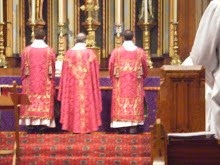
11am Solemn High Mass (BAS Rite I)
4.30pm Festal Evensong & Benediction
Wednesday, June 30, 2010

Monday, June 28, 2010
Undergraduate options I decided against
*Midwifery at the University of British Columbia, Vancouver
*Psychiatric nursing at Brandon University in Manitoba
*Basque Studies at the University of Nevada at Reno
*A double major in sexual diversity studies and the (now sadly defunct) psychoanalytic thought at the University of Toronto (the former through University College, the latter at Trinity) or alternatively in Christianity & Culture and Celtic Studies (at St Mike's)
*Jewish music at Yeshiva University in New York
*Canadian Literature at the University of Victoria, British Columbia
*Cultural Studies and Critical Theory at McMaster University in Hamilton, Ontario
*Culinary Arts at the Dublin Institute of Technology
*Civil law at the University of Ottawa
*Journalism at the University of King's College, Halifax
*Orthodox Theology at the Greek Orthodox Theological Academy of Toronto through the Université de Sherbrooke, Québec
*Psychiatric nursing at Brandon University in Manitoba
*Basque Studies at the University of Nevada at Reno
*A double major in sexual diversity studies and the (now sadly defunct) psychoanalytic thought at the University of Toronto (the former through University College, the latter at Trinity) or alternatively in Christianity & Culture and Celtic Studies (at St Mike's)
*Jewish music at Yeshiva University in New York
*Canadian Literature at the University of Victoria, British Columbia
*Cultural Studies and Critical Theory at McMaster University in Hamilton, Ontario
*Culinary Arts at the Dublin Institute of Technology
*Civil law at the University of Ottawa
*Journalism at the University of King's College, Halifax
*Orthodox Theology at the Greek Orthodox Theological Academy of Toronto through the Université de Sherbrooke, Québec
Sunday, June 27, 2010
A truant Mattins
We fled the city for the duration of the G20 summit, and visited the Church of St John the Evangelist in Elora, Ontario, near Kitchener-Waterloo. The Choral Mattins advertised for second and fourth Sundays was, alas, mysteriously dispensed. Instead we had a Choral Eucharist of Trinity IV.
The service was surprisingly faithful to the BCP. The (Merbecke) Gloria, however, was moved to the beginning, which led to some calisthenics as the entrance rite was otherwise done kneeling. The vesture had the air of pre-Ritualist Tractarianism: the celebrant wore a surplice and stole and faced east on an altar covered in a superfrontal (though he lost his nerve and spun round at the Words of Institution, posts passim). A burse and veil were used, as well as one of those twee little stoles for the lectern. The only spiky touch was the use of apparelled amices on the servers. All the ministers in the sanctuary knelt round the altar for most of the service.
The prayer book lectionary was used, a rarity these days outside of places like St Bart's in Toronto. The gradual psalm, however, was neither that appointed in the prayer book nor the RCL psalm. The last verse was sung as an Alleluia (also the custom at St Bart's) but after springing to my feet reflexively I found myself alone. All rose when the Gospeller (a laywoman from the nave) reached the lectern.
The Nicene Creed was said and the celebrant ascended the pulpit. The rest of the service was prayer book to the letter, complete with manual actions - "He brake it (crack!)" - and post-communion Lord's Prayer. The people joined in the second half of the Thanksgiving ("And here, we offer...") which is common, just as many places also have the Collect for Purity said by all. This phenomenon is likely a part of "organic development" - in earlier editions of the BCP, even the Prayer of Humble Access was said in the congregation's name.
The music of the Mass, incidentally, was Hassler's Missa Secunda. Mozart's Ave Verum Corpus was sung by the excellent choir of St John's. (The music director is also artistic director of the famed Elora Festival, whose choir sings at the church when the festival is underway). It was a rare treat finding such authentic old-fashioned high-and-dry Anglicanism in the country - and I shall return for Mattins!
The service was surprisingly faithful to the BCP. The (Merbecke) Gloria, however, was moved to the beginning, which led to some calisthenics as the entrance rite was otherwise done kneeling. The vesture had the air of pre-Ritualist Tractarianism: the celebrant wore a surplice and stole and faced east on an altar covered in a superfrontal (though he lost his nerve and spun round at the Words of Institution, posts passim). A burse and veil were used, as well as one of those twee little stoles for the lectern. The only spiky touch was the use of apparelled amices on the servers. All the ministers in the sanctuary knelt round the altar for most of the service.
The prayer book lectionary was used, a rarity these days outside of places like St Bart's in Toronto. The gradual psalm, however, was neither that appointed in the prayer book nor the RCL psalm. The last verse was sung as an Alleluia (also the custom at St Bart's) but after springing to my feet reflexively I found myself alone. All rose when the Gospeller (a laywoman from the nave) reached the lectern.
The Nicene Creed was said and the celebrant ascended the pulpit. The rest of the service was prayer book to the letter, complete with manual actions - "He brake it (crack!)" - and post-communion Lord's Prayer. The people joined in the second half of the Thanksgiving ("And here, we offer...") which is common, just as many places also have the Collect for Purity said by all. This phenomenon is likely a part of "organic development" - in earlier editions of the BCP, even the Prayer of Humble Access was said in the congregation's name.
The music of the Mass, incidentally, was Hassler's Missa Secunda. Mozart's Ave Verum Corpus was sung by the excellent choir of St John's. (The music director is also artistic director of the famed Elora Festival, whose choir sings at the church when the festival is underway). It was a rare treat finding such authentic old-fashioned high-and-dry Anglicanism in the country - and I shall return for Mattins!
Thursday, June 24, 2010
The Nativity of St John the Baptist

Montréal is an incredible place. Just walking down the street is a novel experience for those formed in the mores of Orange Ontario. Beer and wine appear in convenience stoor windows, the pedestrian traffic signals are guidelines, and somewhere a spliff is burning. My worldlier friends describe it as "the only place you can touch the strippers" which sounds a little like one of those legal urban myths that you'd get in a bubble gum wrapper. (It is said, for example, that the Fairmont Le Reine Elizabeth must provide a bag of oats for your horse). In middle school, the grade 8s boasted about the tattoos they would get as we stopped at Tim Horton's franchises in Kingston. After the fact, none owned up to having done such a thing, though a few went home sporting short-lived piercings.
Today was the patronal festival of Québec and the Anglican Church of Canada. A Solemn High Mass (sans procession or Te Deum) was celebrated in English and French (well, Latin and Greek if you count the choral parts) according to the rite of the prayer book of 1959 and the traditional Western Rite at the Church of St John the Evangelist. A lovely blue and gold High Mass set was used, complete with maniples and a humeral veil for the subdeacon. The birettas which I saw for the first time at St John's were not in evidence. Hymns were from the English Hymnal, and the Epistle read but the Gospel monotoned rather hurriedly. A satisfying lunch of hamburgers and hot dogs followed. Home tomorrow.
Tuesday, June 15, 2010
From the Anglican Journal comments
"The document and speakers referenced a paradox in our life as a church. Unfortunately the paradox only exists for those unaffected by continued inaction. For those who don't actually enjoy the 'full inclusion' the document would suggest, there is only injustice. Someone has to pay the price for unity, I'm just sad it has to be me."
Friday, June 11, 2010
Old Catholic schizophrenia
Bishop David Hamid, suffragan to the Bishop of Gibraltar in Europe, blogs about a particularly bizarre effect of the Archbishop of Canterbury's purge: the removal of the rector of Frankfurt in the Convocation of American Churches in Europe from the Anglican dialogue with the Old Catholic churches. It seems that ++Rowan fears the Episcopal Church's voice cannot be trusted not to contaminate our representation to even the Old Catholics - who are ahead of us in permitting the blessing of same-gender unions and the ordination of gay clergy! It is hard to see how, unlike perhaps with Rome or the Orthodox, the dialogue would be upset by an American representative. Of course, the Archbishop is not about to withdraw his own participation from Communion affairs: as a bishop in the CoE he's free to bless as many such unions as he likes in his province so long as they remain "informal."
Thursday, June 10, 2010
Pastoral generosity
On the order paper today is resolution C009, moved by an openly gay youth member from the Diocese of Toronto. The text is as follows.
Affirm that the most generous pastoral response possible be provided to people in committed same sex relationships; and that in dioceses, with the approval of the diocesan bishop, the most generous pastoral response in each individual context be determined.
This motion is very clever. By granting a local option (the bishop is empowered to determine what constitutes appropriate pastoral care) without saying so outright (the "b" word does not appear) it avoids the Archbishop of Canterbury's jesuitical definition of "formal." It is not the blessing of same-gender unions itself that is problematic for ++Rowan, for such is the common practice of his own province, so long as we do not use the word in a formally enacted resolution.
UPDATE The motion, which was the only way we were going to salvage anything out of this mess, has been withdrawn.
Affirm that the most generous pastoral response possible be provided to people in committed same sex relationships; and that in dioceses, with the approval of the diocesan bishop, the most generous pastoral response in each individual context be determined.
This motion is very clever. By granting a local option (the bishop is empowered to determine what constitutes appropriate pastoral care) without saying so outright (the "b" word does not appear) it avoids the Archbishop of Canterbury's jesuitical definition of "formal." It is not the blessing of same-gender unions itself that is problematic for ++Rowan, for such is the common practice of his own province, so long as we do not use the word in a formally enacted resolution.
UPDATE The motion, which was the only way we were going to salvage anything out of this mess, has been withdrawn.
Subscribe to:
Posts (Atom)