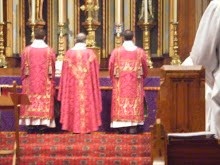
Much ink has been spilled over the concept of Anglican patrimony, but some of the candidates are more dubious than others. Is the reintroduction of traditional Latinate ceremonial (and I of all people mean that in no wise pejoratively) really a gift of Anglicanism to the church catholic? The Use of Sarum has been mentioned by some: others may dismiss it at as antiquarianism, but its recovery seems to have been relatively unproblematic in the Orthodox Church. (I continue to regard the Orthodox Western Rite as a more attractive options for Anglicans with swimming fever, though for various reasons I am not on the market myself. Nevertheless, TAC and its co-petitioners have won the goal of several generations of Anglo-Papalists and their integrity and readiness in "answering the call can only be commended).
Having said that, there are, I think, differences we can observe in the piety of Anglican Catholics and their counterparts in communion with Rome. Although I at first swam the Thames with Henrician intentions of remaining unchanged doctrinally and in practice, diligently praying the rosary and making periodic trips to the confession rail (boxes being nowhere to be found), there are certain things one does not generally find either in Anglican or in Roman Catholic churches.
Any kind of public Office is scarce as hen's teeth in the Roman Catholicism, although the Toronto Oratory offers the archdiocese's only Sunday Vespers (solemn, in the ordinary form, mostly in Latin, and with Benediction). There I notice that worshippers wandered in and out relatively casually - not irreverently, but clearly feeling no obligation to remain in a pew from ten minutes prior the service to the postlude or extinguishing of candles. Indeed, I have childhood memories of trips to the bathroom during the homily - you couldn't get there without passing the tabernacle and so you learned to genuflect with minimum pressure on the bladder.
Although there is the odd rosary group and Mass of the Sacred Heart, and Benediction remains a crowd-pleaser, the plethora of devotional options simply does not exist to the same extent in Anglicanism. It occurs to me that I don't know off hand where my brown scapular and Miraculous Medal are which I once doffed only to shower. Certainly the menu of Divine Mercy chaplets, perpetual Adoration, and Novenas to the Infant of Prague is not a feature of Anglican churches.
Roman Catholic churches often lack a cogent sense of community outside of worship. While many Anglicans cannot conceive of a Mass not followed by the eighth sacrament, coffee, in the church of my childhood "Coffee Sunday" was a once a month affair, and only if you happened to attend the 11am Mass after catechism instead of the 9am prior to, as most families with young children preferred. (As a teenager, I came to be partial to the Mass of anticipation and sleeping in on Sunday mornings). I certainly did not speak to other parishioners outside of the nave on regular basis. They can have a certain warehouse feel: friends tell of Masses being discontinued for attracting "only" 150 or so week by week - for Anglicans, an impressive figure for all Sunday services combined. Even outside of Anglo-Catholicism, Anglican congregations offer a "boutique" niche.
And so while communities of Anglicans received into full communion with the Holy See will be subject to the same doctrinal standards as other Roman Catholics, it seems fair to say that there are noticeable differences in the piety of Anglo-Catholicism that can be hoped to enrich the wider Roman communion in a real way.
Saturday, August 7, 2010

Sunday, July 25, 2010
Pushback
Both the MadPriest and The Anglo-Catholic are carrying the story of a playwright who feels marginalized at Toronto's Church of St Mary Magdalene over his "traditional" views on same-sex relationships. Following on the heels of the "dog bites God" story making the rounds, this one plays into a favourite conservative trope: the "illiberal liberal."
This tactic allows reasserters to shift attention from their own pet intolerance (marriages that fall short of the sacred penis-in-vagina ideal) by turning the principles of theological liberalism on their head. See, "liberals" aren't tolerant of intolerance, so we must be intolerant ourselves, get it? Of course, it's only a semantic trick, but it sounds like a good talking point and is second perhaps only to the "bums on pews" trope in terms of dangerous equivocation. (Churches that welcome gays, we are told, are hemorrhaging members - the paradoxical implication being that the way to fill churches is to restrict eligibility for membership).
As usual, the comparison is one of apples and oranges. Mr McKillop wrote a play, on the public record, that is openly disparaging of the plight of gays in the church who seek its blessing. Whether he agrees with them or not, that he then expects to be able to waltz into a community to which a fair number of such people have given their lives and be "welcomed" is the height of hubris. Now, a rational person would say, of course a gay couple in the choir is going to be unnerved by your presence. But in reasserter Bizarro World, it is the gay couple who are the bigots with their ungracious reception of him. Mr McKillop protests that he said nothing to the men "while singing" and so he cannot understand their rudeness and assumes the snub is attributable to "something they had heard about me or what I had written" (gee, ya think?) Funny that - gays can read? If I insult someone else in writing, it still counts? Go figure. I mean, if I had written negatively about black Canadians, I could hardly then show up at the local British Methodist Episcopal church and expect a warm welcome so long as I don't mention verbally what I've already made clear in print.
The headline of the piece is 'An Anglican who no longer feels safe.' This is particularly sneaky prose, since of course it is clearly the gay couple who would be made to feel less than safe by the arrival of a wag like Mr McKillop. This couple has presumably been singing without incident for some time before someone with an agenda showed up to make trouble. I'm sure I would have been similarly concerned in their shoes. My parish family is very important to me and if someone arrived who openly believed that my belonging there was an abomination I would of course consider that a threat. But because they cannot win the battle on theological grounds, "reassserters" have simply inverted the terminology. Now, the Anglican Church of Canada's tepid efforts to afford its gay and lesbian members a modicum of respect are portrayed as a campaign to hound out others. Since they can't argue with trying to make a few people feel a bit more safe, they spin it around and accuse the liberals of what they themselves have hitherto been doing. So now the slow move of the Anglican Church into the 20th century (only ten years late and counting!) is depicted not as a measure of greater safety (for gays) but less. The same phenomenon can be seen at synod where Essentials show up with their Zacchaeus Fellowship, whose mind-bending premise is that by allowing gays and lesbians who wish to enter committed relationships to do so, the church is somehow not respecting the rights of those who do not so wish (!)
Heterosexual Anglicans like Mr McKillop are eminently safe. For most of the church's history, they were the only ones who were. Now efforts are being made to extend that safety to others. But doing so does not diminish the safety of heterosexuals - instead, for once, it simply isn't about them. If Mr McKillop feels unsafe it is because of statements he has chosen to make publicly. That those whom he has attacked take umbrage at his presence is not some conspiracy - it is the consequence of his own actions.
So like much of the reasserter literature on homosexuality, Mr McKillop's tantrum in the Putz is high on scary sounding rhetoric and low on theology (see for example this post, whose author when challenged on his talking points tacitly confessed his inability to defend his matching-bits fetish on theological grounds). If Mr McKillop wishes to inhabit a church where he can write whatever venom he likes about gays on Saturday and they will docilely shake his hand at the Pax on Sunday, he is welcome to the Roman Catholic Church. Anglican gay folk reserve the right to be uppity.
Like Republicans in the United States, conservatives have a tendency to confuse losing with oppression. Finding themselves on the wrong side of history their only chance is to make as much noise as possible on the way out, in hopes of momentarily stunning us. But to anyone who has taken a first-year "reading critically" course, Mr McKillop's column is transparently hollow. While their argument has been indulged until now - and for too long - on the strength of its age, it is becoming clear that the Emperor has no clothes. While reasserters hate the comparison of the gay civil rights movement to its African American antecedent, they do not give people under 30 a reason to resist the analogy. Most of us believe that segregation was wrong not because blacks are some sacredly protected class but because it is unjust to treat a class of persons differently because of an involuntary personal characteristic. To hold this in the case of one group but not another is special pleading. In fact it is simply that the self-styled "orthodox" (who fought desegregation just as hard as gender-neutral marriage) have given up one prejudice but not yet another.
Monday, July 12, 2010
Sea Sunday
The Mission to Seafarers in the Port of Toronto celebrated an outdoor Solemn Votive Mass of Michaelmas yesterday afternoon, just managing to avoid the rain. A couple of us turned up from St Bart's, where the mission's chaplain assists informally and had invited us that morning to binate.
The chaplain celebrated with the mission's other priest and a local priest of the Oratory of the Good Shepherd as assistants. Archbishop Terry Finlay turned up in the congregation in his role as Episcopal Visitor and gave the final blessing.
We sang hymns and modern settings of the Mass ordinary, including the "Land of Rest Sanctus" from Evangelical Lutheran Worship, with synthesizer organ and tambourine accompaniment provided by the diocese's Filipino congregation. The Gloria was a hymn paraphrase to the tune of Angels we have heard on high, and was followed by the Kyrie (in Greek) to Rule, Britannia, which we tried to fake, but it didn't really take off. A collect of St Nicholas, patron of seafarers, was commemorated.
An amply appointed barbecue followed, by which time the oppressive humidity had broken. (Other parts of the city, as I learned when I returned home, had been shaken by thunderstorms).
Wednesday, June 30, 2010
Max's service schedule challenge
Source here.
Rural
8.30am Holy Communion (BCP)
10.45am Morning Prayer
11am Sung Eucharist (BAS or alternating)
Suburban
5pm (Sat) Corporate Confession & Absolution with Anointing (ELW)
8.30am Holy Communion (BAS Rite I)
10.45am Morning Prayer
11am Sung Eucharist
(Morning Prayer and Holy Communion, first Sundays)
Inner city
4pm (Sat) Corporate Confession & Absolution with Anointing (ELW)
5pm La Messe-Basse
9.30am Holy Communion (BCP)
10.15am Sung Mattins & Litany
11am Solemn High Mass (BAS Rite I)
4.30pm Festal Evensong & Benediction
Monday, June 28, 2010
Undergraduate options I decided against
*Midwifery at the University of British Columbia, Vancouver
*Psychiatric nursing at Brandon University in Manitoba
*Basque Studies at the University of Nevada at Reno
*A double major in sexual diversity studies and the (now sadly defunct) psychoanalytic thought at the University of Toronto (the former through University College, the latter at Trinity) or alternatively in Christianity & Culture and Celtic Studies (at St Mike's)
*Jewish music at Yeshiva University in New York
*Canadian Literature at the University of Victoria, British Columbia
*Cultural Studies and Critical Theory at McMaster University in Hamilton, Ontario
*Culinary Arts at the Dublin Institute of Technology
*Civil law at the University of Ottawa
*Journalism at the University of King's College, Halifax
*Orthodox Theology at the Greek Orthodox Theological Academy of Toronto through the Université de Sherbrooke, Québec
Sunday, June 27, 2010
A truant Mattins
We fled the city for the duration of the G20 summit, and visited the Church of St John the Evangelist in Elora, Ontario, near Kitchener-Waterloo. The Choral Mattins advertised for second and fourth Sundays was, alas, mysteriously dispensed. Instead we had a Choral Eucharist of Trinity IV.
The service was surprisingly faithful to the BCP. The (Merbecke) Gloria, however, was moved to the beginning, which led to some calisthenics as the entrance rite was otherwise done kneeling. The vesture had the air of pre-Ritualist Tractarianism: the celebrant wore a surplice and stole and faced east on an altar covered in a superfrontal (though he lost his nerve and spun round at the Words of Institution, posts passim). A burse and veil were used, as well as one of those twee little stoles for the lectern. The only spiky touch was the use of apparelled amices on the servers. All the ministers in the sanctuary knelt round the altar for most of the service.
The prayer book lectionary was used, a rarity these days outside of places like St Bart's in Toronto. The gradual psalm, however, was neither that appointed in the prayer book nor the RCL psalm. The last verse was sung as an Alleluia (also the custom at St Bart's) but after springing to my feet reflexively I found myself alone. All rose when the Gospeller (a laywoman from the nave) reached the lectern.
The Nicene Creed was said and the celebrant ascended the pulpit. The rest of the service was prayer book to the letter, complete with manual actions - "He brake it (crack!)" - and post-communion Lord's Prayer. The people joined in the second half of the Thanksgiving ("And here, we offer...") which is common, just as many places also have the Collect for Purity said by all. This phenomenon is likely a part of "organic development" - in earlier editions of the BCP, even the Prayer of Humble Access was said in the congregation's name.
The music of the Mass, incidentally, was Hassler's Missa Secunda. Mozart's Ave Verum Corpus was sung by the excellent choir of St John's. (The music director is also artistic director of the famed Elora Festival, whose choir sings at the church when the festival is underway). It was a rare treat finding such authentic old-fashioned high-and-dry Anglicanism in the country - and I shall return for Mattins!
Thursday, June 24, 2010
The Nativity of St John the Baptist

Montréal is an incredible place. Just walking down the street is a novel experience for those formed in the mores of Orange Ontario. Beer and wine appear in convenience stoor windows, the pedestrian traffic signals are guidelines, and somewhere a spliff is burning. My worldlier friends describe it as "the only place you can touch the strippers" which sounds a little like one of those legal urban myths that you'd get in a bubble gum wrapper. (It is said, for example, that the Fairmont Le Reine Elizabeth must provide a bag of oats for your horse). In middle school, the grade 8s boasted about the tattoos they would get as we stopped at Tim Horton's franchises in Kingston. After the fact, none owned up to having done such a thing, though a few went home sporting short-lived piercings.
Today was the patronal festival of Québec and the Anglican Church of Canada. A Solemn High Mass (sans procession or Te Deum) was celebrated in English and French (well, Latin and Greek if you count the choral parts) according to the rite of the prayer book of 1959 and the traditional Western Rite at the Church of St John the Evangelist. A lovely blue and gold High Mass set was used, complete with maniples and a humeral veil for the subdeacon. The birettas which I saw for the first time at St John's were not in evidence. Hymns were from the English Hymnal, and the Epistle read but the Gospel monotoned rather hurriedly. A satisfying lunch of hamburgers and hot dogs followed. Home tomorrow.
Subscribe to:
Posts (Atom)